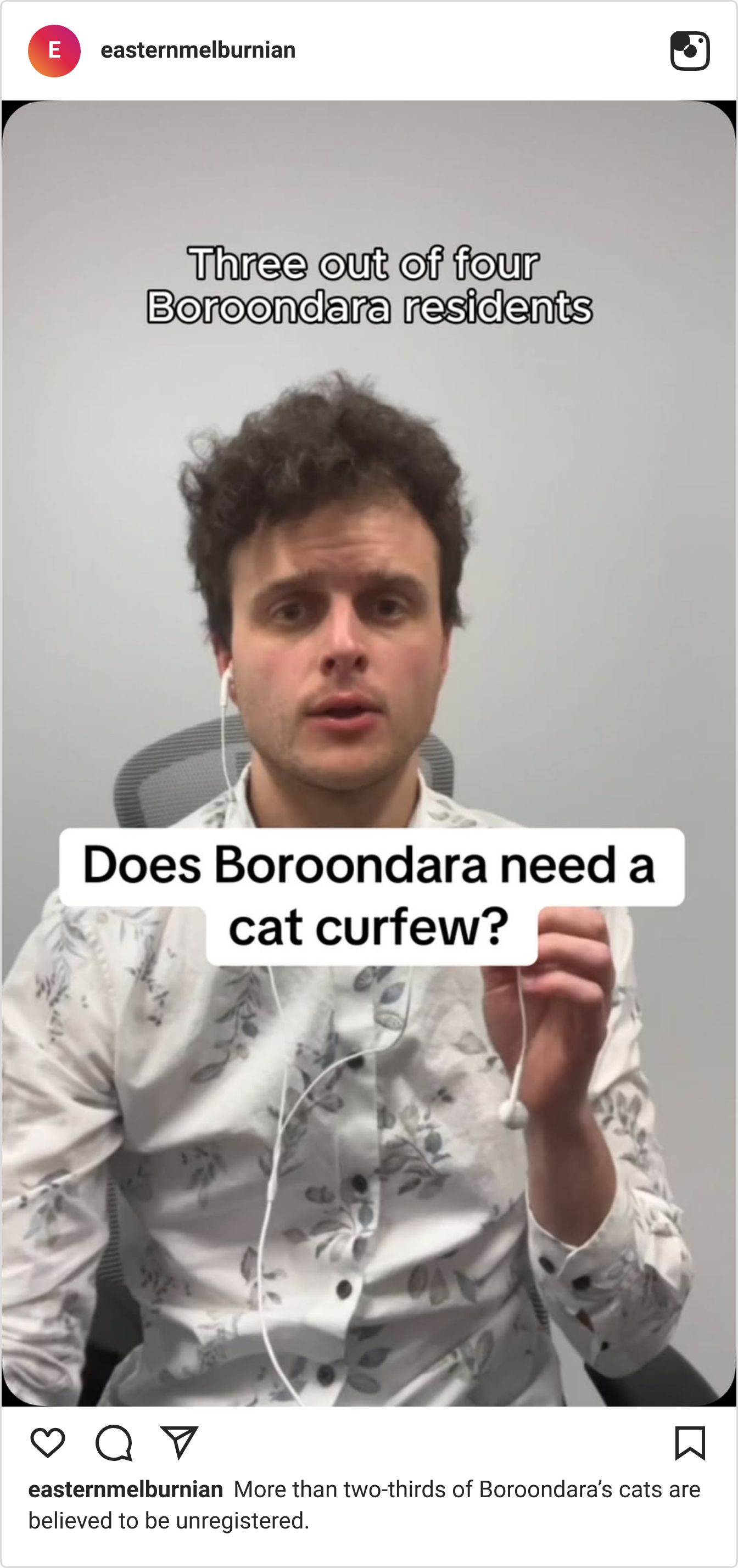

More than three in four Boroondara residents want some form of cat curfew, but council officers are recommending improved education instead.
What's happening? At the council meeting on July 27, councillors will be able to choose from five options, including a complaint-based enforcement model — where the council would only investigate reports from residents rather than actively patrol for cats — or a night-time curfew trial from January 2027 to July 2029.
The problem: Boroondara is estimated to have 14,987 cats, including 4,816 registered and 10,171 unregistered.
Between October 2025 and May 2026, the council received 22 complaints about cat nuisance, half involving people feeding stray cat colonies. During the same period, it received 282 dog-related complaints, including 94 dog attacks.

How would it work? Under a curfew, residents could humanely trap roaming cats and ask the council to collect them.
The owners of registered cats would usually receive a warning for a first offence before a $102 fine for follow-up infringements. Unregistered cats would be impounded, with fines only issued if an owner claimed them.

The broader issue: Council officers say a curfew would likely increase impoundments, nuisance complaints and the number of unregistered cats.
The number of cat impoundments in Boroondara has risen from 264 in 1998 to 2,058 in 2024-25. The report estimates the council would need to trap up to 5,085 unregistered cats every six months for more than a decade to significantly reduce stray numbers, resulting in many cats being euthanised.
Locals split: More than 3,650 residents responded to consultation, with support almost evenly split between a night-time curfew (38.4 percent), a 24-hour curfew (37.8 percent) and no change (23.8 percent).
Thumbnail Image Credit: Hasan Ölker/Pexels