
With Melbourne currently in the middle of a heatwave, public transport for many is an easy way to get across town in relative comfort.
But Australia is only getting hotter – and the rising temperature’s impact on our public transport system is only going to increase.
Currently, around one-in-three trams operate without air conditioning in Victoria, while elsewhere hot days can cause heat-enforced speed restrictions on trains. Millions of dollars are spent every week on maintenance across the state’s public transport system – while investment into roads and tunnels for cars seems to take priority.
It begs the question: Just how well equipped is Melbourne’s public transport for a hotter climate?
🌡️How hot is Australia getting? A heatwave warning is in place for Melbourne until Saturday, with the temperature reaching as high as 42 degrees on Wednesday.
According to the Bureau of Meteorology’s 2025 preliminary summary, Australia experienced its fourth-warmest year on record last year, with temperatures 1.23 degrees above the 1961-1990 average.
The National Climate Risk Assessment, released last year, shows the number of extreme heat days in the country will increase from four to 18 days a year if no drastic action is taken.
Since 1960, the number of record hot days in Australia has doubled and heatwaves have become longer, hotter and more intense.

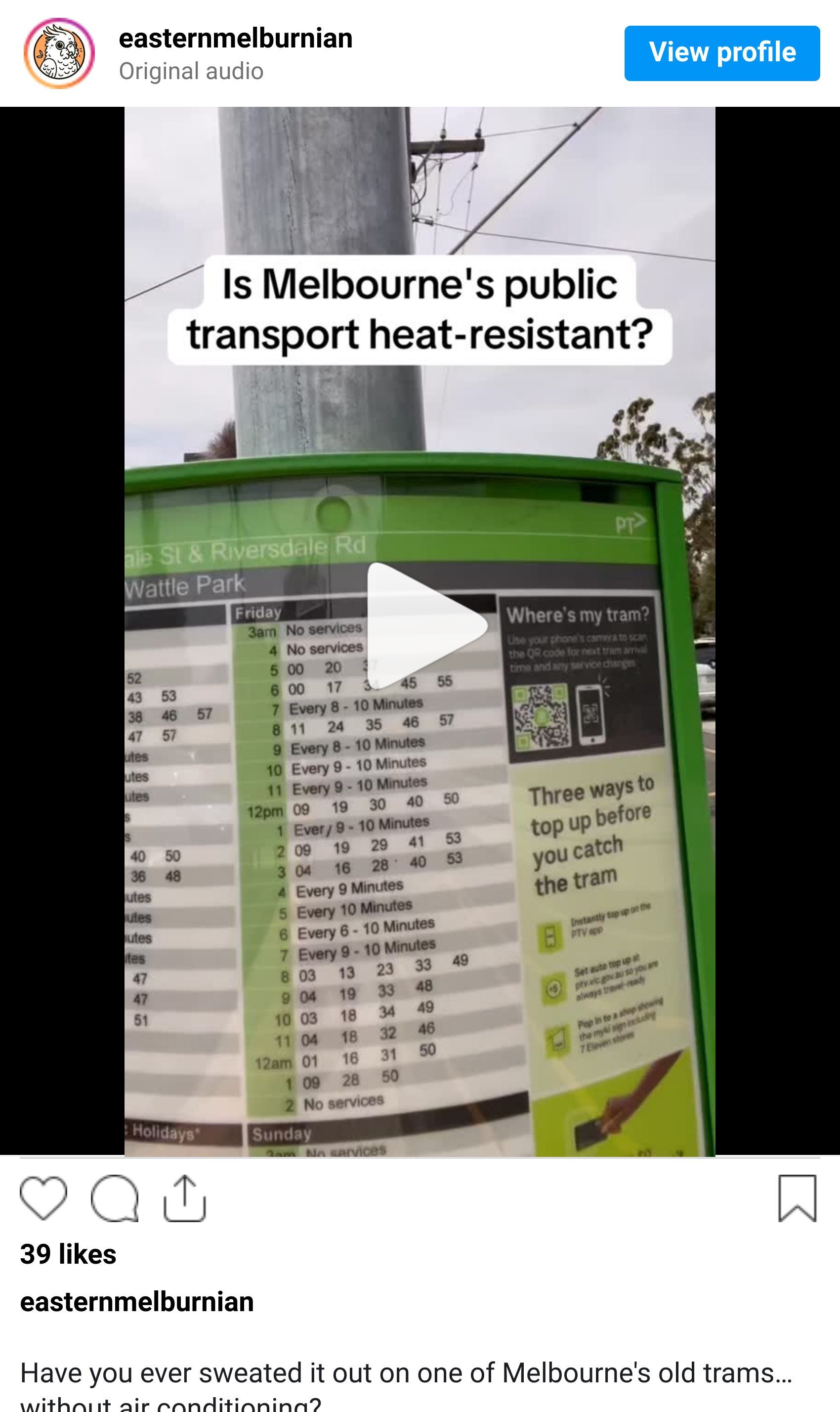
🥵 Sweating it out: About a third of Melbourne’s tram fleet does not have air-conditioning, with speed restrictions also introduced on extreme heat days to reduce the strain on infrastructure, such as buckling tracks and sagging overhead power lines.
While network testing is underway to roll out 100 new G-Class trams, Public Transport Users Association spokesperson Daniel Bowen said the “progress on this has been slow”.

Public Transport Users Association spokesperson Daniel Bowen said trams from the 1970s and 1980s needed to be phased out.
🗣️ “There are still over 100 older trams with no air-conditioning, which likely means stifling heat in these trams,” Bowen told the Eastern Melburnian.
🛤️ Trains under strain: The Metro Trains system also has to adapt to the heat, spending about $12 million each week on infrastructure, trains and technology maintenance and renewal works.
Specific actions to reduce the impact of extreme heat conditions include painting the outside of signal boxes with heat-reflective paint and real-time temperature monitoring technology to accurately apply speed restrictions when the rail temperature surpasses 55 degrees.

😎Cooler transport connections: Sweltering Cities executive director Emma Bacon joined members of her team on Wednesday to record the radiant heat on the ground at a number of Melbourne tram and bus stops with the maximum reading reaching 68.4 degrees.
🗣️ “Our inadequate public infrastructure is exposing people to extremely dangerous temperatures on hot days,” Bacon told the Eastern Melburnian.

Sweltering Cities executive director Emma Bacon was out and about measuring radiant heat on the ground near tram and bus stops on Wednesday.
🤔Freedom of choice: University of Melbourne Faculty of Architecture, Building and Planning honorary senior fellow Dr John Stone said significant investment into road projects like the North East Link “makes it harder and harder for public transport to compete”.
🗣️ “Most of the people in the suburbs are being condemned to car dependence,” Stone told the Eastern Melburnian. “Rather than huge expansions of our road network, we should be putting that money into making the public transport system a viable alternative.”

University of Melbourne Faculty of Architecture, Building and Planning honorary senior fellow Dr John Stone told the Eastern Melburnian more funding for public transport should be prioritised before more road network upgrades.
⏭️ What can be done? Stone said the key focus for the government should be shifting funding towards better maintenance and climate-resilient infrastructure.
🗣️ "As we look to try and reduce the impact of the transport sector's greenhouse emissions, we do have to make public transport an alternative to the car and that means investing in service and in maintenance,” said Stone. “The returns on that, in terms of people's lives, are immense.”