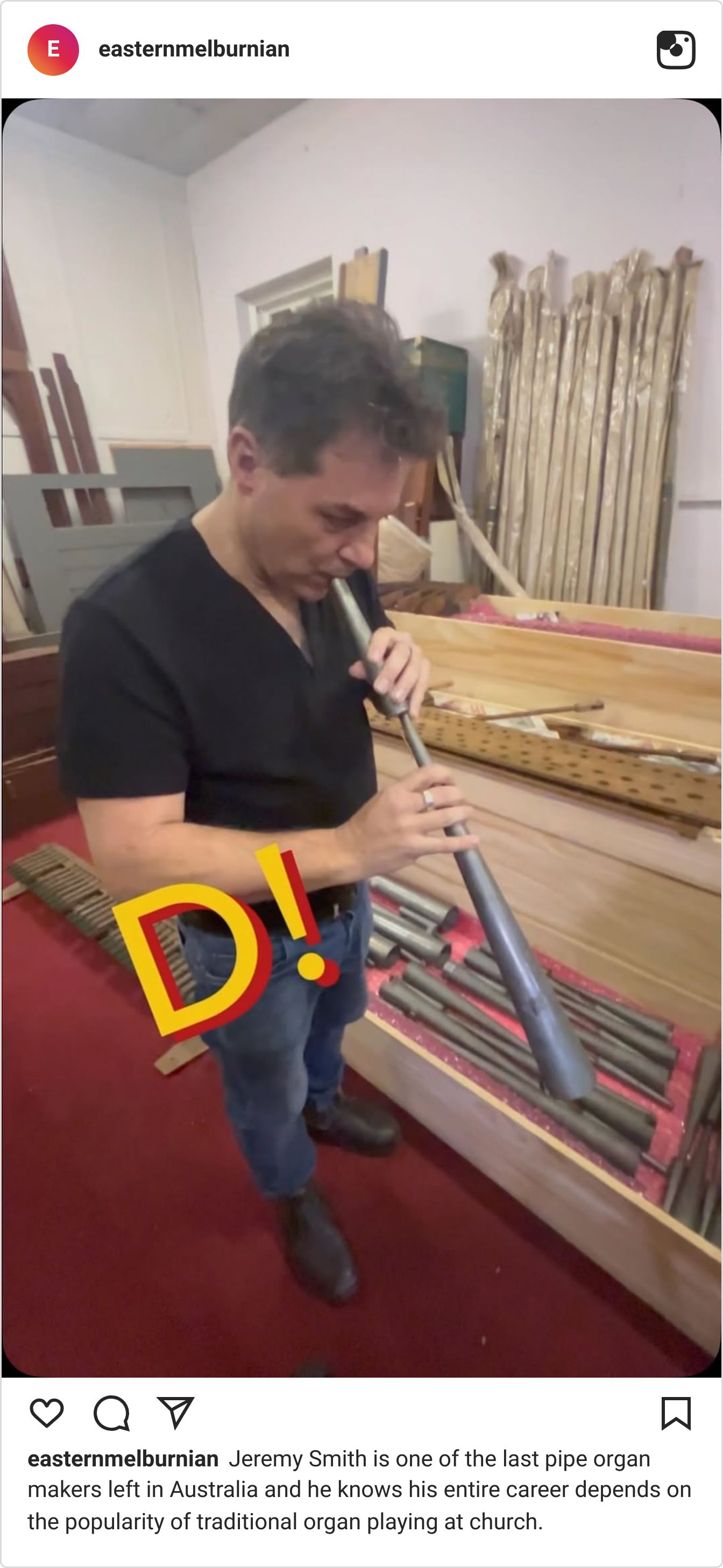

Jeremy Smith is one of the last pipe organ makers left in Australia and he knows his entire career depends on the popularity of traditional organ playing at church.
The eastern suburbs local is currently restoring an organ built in 1874 for use at St Dominic's Catholic Church's in Camberwell — one of about 100 organs he manages across Victoria, Tasmania and South Australia — in a trade that has shrunk as church attendance and funding have dwindled.
🎶 Love at first note: Born in Launceston, Smith began playing piano at five before discovering the organ at 15.
🗣️ “I just liked the sound of the organ … I fell in love with it,” he told the Eastern Melburnian. “A lot of the time, it doesn't feel like work.”
Smith first moved to Melbourne in 1992 as an apprentice with Australian Pipe Organs before joining Wakeley Pipe Organs in 2012 and then becoming a sole trader about four years ago.
Since 1997, he has also been organist at St James’ Anglican Church in Dandenong.

Smith said while many people thought an organ’s sound is only produced via the 50 or so pipes coming out the top, many older organs have from about 900 pipes to 11,000 in the case of the piece at the Melbourne Town Hall.
🔧 Maintaining history: Where organ builders once spent years creating new instruments, Smith now spends 70 percent of his time preserving, tuning and maintaining old ones as leather bellows wear out, timber dries and pipes fall out of tune.
Some cleaning jobs take more than a month, while major restorations can require six people working for up to nine months.
🗣️ “New instruments aren't being made, it's more restorations these days,” he said.

⛪ A changing industry: Smith said the trade has shrunk as church attendance and funding have declined, but he hopes to continue until retirement.
🗣️ “My whole career, and anyone else's in this trade in Australia, is governed by where the churches go in the next decade,” he said. “The industry's small and I think that's what's going to help it.”