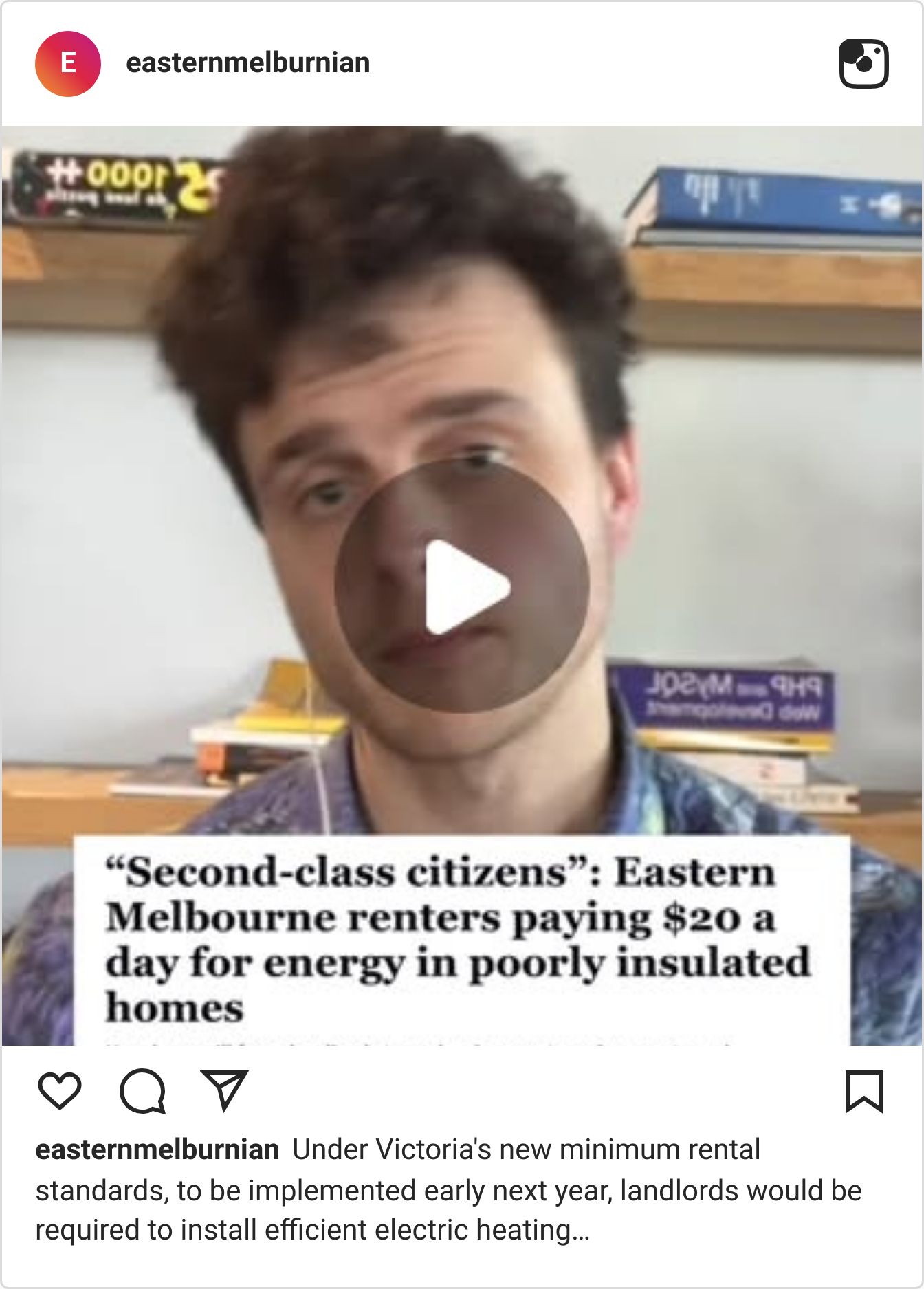

When the gas heater in 60-year-old Ben Kreunen’s Ringwood East rental broke, his landlord replaced it with a new gas system, but did not attend to the home’s poor insulation.
He spends about $400 a month on gas and $200 on electricity.
Under Victoria’s new minimum rental standards, to be implemented early next year, landlords in similar situations would be required to install efficient electric heating and improve insulation — cutting bills for renters across Melbourne’s east.

Ben Kreunen has been renting in Ringwood East for the past 26 years.
🌡️ Better benchmarks: From March 1 2027, landlords and rental providers will be required to deliver new and more efficient systems in heating, cooling, hot water, shower heads, ceiling insulation and draughtproofing.
The standards would apply when an existing system fails or can’t be repaired, at the start of a new rental agreement, or if an annual agreement becomes monthly.
In terms of ceiling insulation, the standards would only apply at the start of a new rental agreement and if there is currently no ceiling insulation in place.
For heating and cooling, landlords would be required to replace an existing heater – most commonly a reverse-cycle system that can heat a space in winter and cool it in summer – when it is broken or malfunctions to a point beyond repair.
For hot water, property owners would have to put in an efficient heat pump water heater or an electric-boosted solar water heater when the current system breaks down.
According to the new legislation, all rental properties must have cooling installed from July 1, 2030, regardless of the rental status.
✅ Many benefits: An uninsulated ceiling accounts for 25 to 35 percent of a home's total heat loss during winter, while upgrading from a conventional hot water heater to an electric heat pump can cut a home’s energy usage by up to 75 percent.
The Energy Efficiency Council’s Rachael Wilkinson said the standards would make rental homes cheaper to run, more comfortable to live in and improve tenant health.
A spokesperson for the Victorian Council of Social Service said the health benefits for low-income renters living in the hottest suburbs with pre-existing health conditions would be “life-saving”.
🥵 🥶 Weather whiplash: Sasha, who spoke on the condition of only giving her first name, has been living in community housing in Box Hill for eight months, and said poor insulation led to her family power bills increasing by at least 25 percent compared to their last rental.
🗣️ “In the summertime, it’s like an oven and in the wintertime, it doesn’t keep the heat in,” Sasha told the Eastern Melburnian. “This summer, it hit 31 degrees at 9am in the morning. In winter, I run the heating as soon as the temperature hits 15 degrees.”
The weather extremes worsened her migraines in the heat and, in the cold, respiratory issues caused by moisture and mould.
⏭️ What’s next? Renters and Housing Union delegate Harry Millward said while the union supported the new standards, the real test would be seeing if they were appropriately enforced.
🗣️ “If you've got rights and they're not being upheld by the system, then they're not real rights,” he told the Eastern Melburnian.
Better Renting is a national organisation working with renters to secure affordable and healthy homes. Deputy director Bernadette Barrett told the Eastern Melburnian: “How standards are enforced are basically as important as the standards themselves. Currently, the onus sits with renters to report non-compliance.”

Left: Renters and Housing Union delegate Harry Millward. Right: Better Renting deputy director Bernadette Barrett.
🤞 Fingers crossed: Kreunen hoped the new standards would give him more confidence to ask for things like better insulation, as he was currently fearful his landlord would prematurely end the lease.
🗣️ “Eventually, over a long period of time, you begin to feel like second-class citizens,” he said. “They can always get rid of us.”
Thumbnail Image Credit: Brett Jordan/yanagi