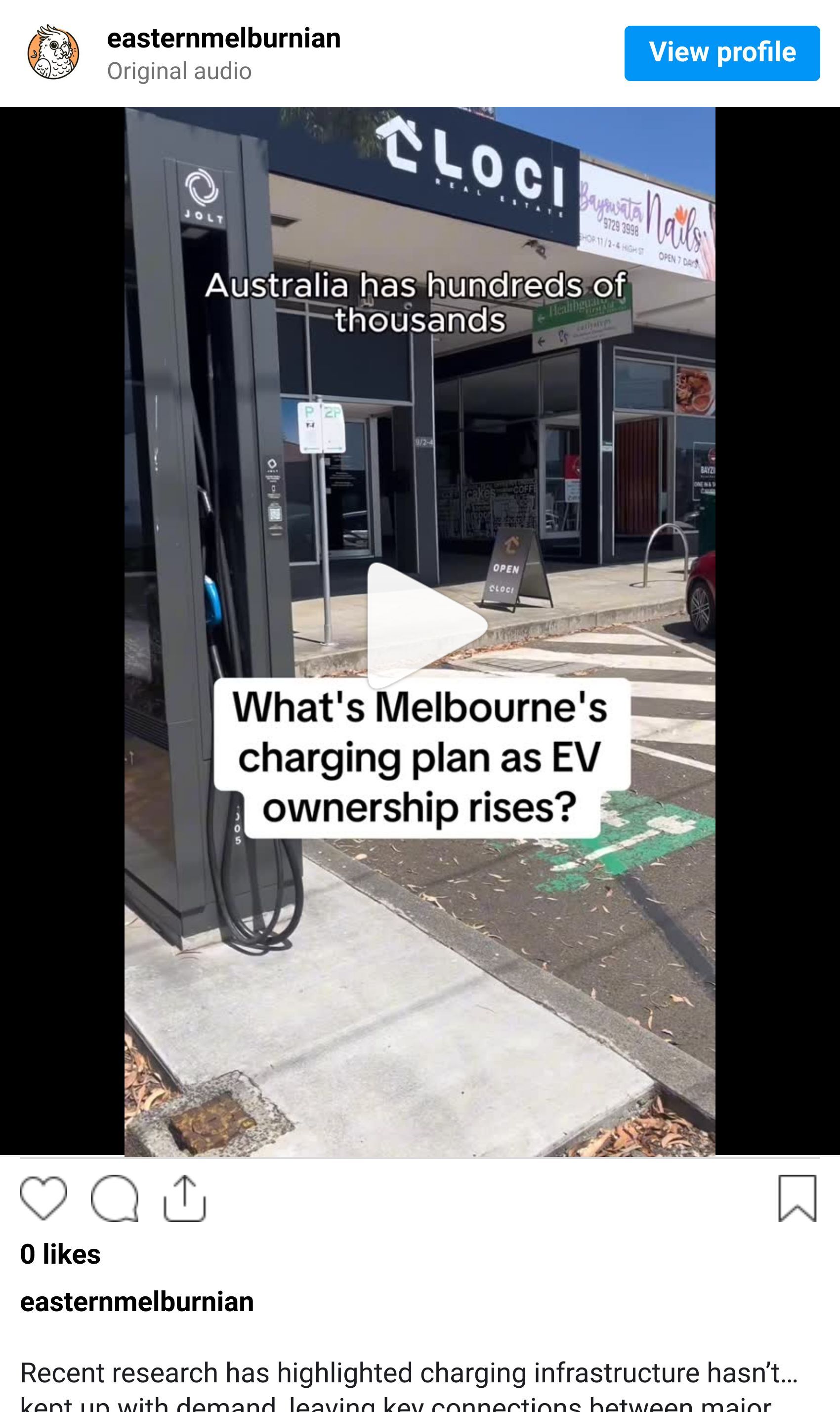

Each year, more and more electric vehicles (EVs) hit the road in Melbourne and greater Victoria.
However, recent research has highlighted charging infrastructure hasn’t kept up with demand, leaving key connections between major cities as “charging deserts”.
🔌 Rising interest, lower supply: According to a report from the Australian Automobile Association (AAA), the latest data from the July to September period showed EV sales in Victoria accounted for about 11 percent of new vehicle sales, up from seven percent a year prior.
While there are about 7,000 petrol stations dotted around Australia, electric vehicle (EV) owners – about 410,000 as of last September – were less spoilt for choice, with about 1,250 public charging stations offering about 3,750 ports.
Australian Electric Vehicle Association Victorian branch director, Riz Akhtar, said while Victoria was gaining traction, with about 95,000 EVs on the road, the state was “quite a bit behind” other states like New South Wales, which recently surpassed 104,000 EVs on its roads.
🗣️ “The government says they want to do all these things, but they don't realise the amount of investment that's needed and how to drive that investment forward,” Akhtar told the Eastern Melburnian.

Australian Electric Vehicle Association Victorian branch director Riz Akhtar.
❓What are governments doing? The Federal Government has committed $40 million to accelerate the deployment of EV charging infrastructure towards reaching 10,000 public chargers nationwide.
The State Government is also conducting an inquiry into the electricity supply for electric vehicles, with hearings set to take place covering topics such as whether public charging infrastructure is being rolled out quick enough across Victoria.
📍 Connecting our regions: Swinburne University of Technology Centre of Sustainable Infrastructure Associate Professor, Hussein Dia, helped develop the Australian EV Infrastructure Monitor – an online mapping tool showing where charging stations exist across Australia.
Dia said more than two-thirds of towns have no charger within five kilometres, meaning long trips had created what is known as “range anxiety”.
🗣️ “Charging infrastructure should not be dictated by the postcode where we live,” Dia told the Eastern Melburnian. “If we really want to provide adequate uptake of EVs, we need to have an equitable distribution of where the uptake is. It is just not acceptable to go on a trip and know, even if you are fully charged, that the next charging station is 300 kilometres away.”

Swinburne University of Technology Centre of Sustainable Infrastructure Associate Professor Hussein Dia.
🪙 What are local councils doing? Knox Council recently endorsed its Electric Vehicle Charging Infrastructure Policy, which outlined a new 25 cents per kilowatt-hour fee for those wanting to charge at a council-owned charging station.
⏰ A long line: Rob Law, an EV owner living in a regional town northwest of Melbourne, said he was less anxious about having enough charge to get to his destination.
🗣️ “The good news is that there's more and more chargers, but the challenge now is keeping up with the demand,” Law told the Eastern Melburnian. “I'm often finding that I have to wait up to an hour or two just to use a single charger.”

Rob Law, an EV owner from a regional town northwest of Melbourne, said long queues of people waiting to charge their cars is something that still needs to be solved.
💨 Speeding up the transition: Dia said more government incentives needed to be made available to charging infrastructure providers looking to install in regional or rural areas to quickly catch up with growing demand.
For instance, Dia said the Western Australian Government had shown positive initiative by funding up to 50 percent of the cost of electric vehicle charger installations for companies, local governments and not-for-profits.
🗣️ “I think the private sector is crying out for these guidelines,” said Dia. “You need to put the infrastructure in place, even in the beginning and as we get more vehicle electric vehicle uptake, they will get better utilisation.”