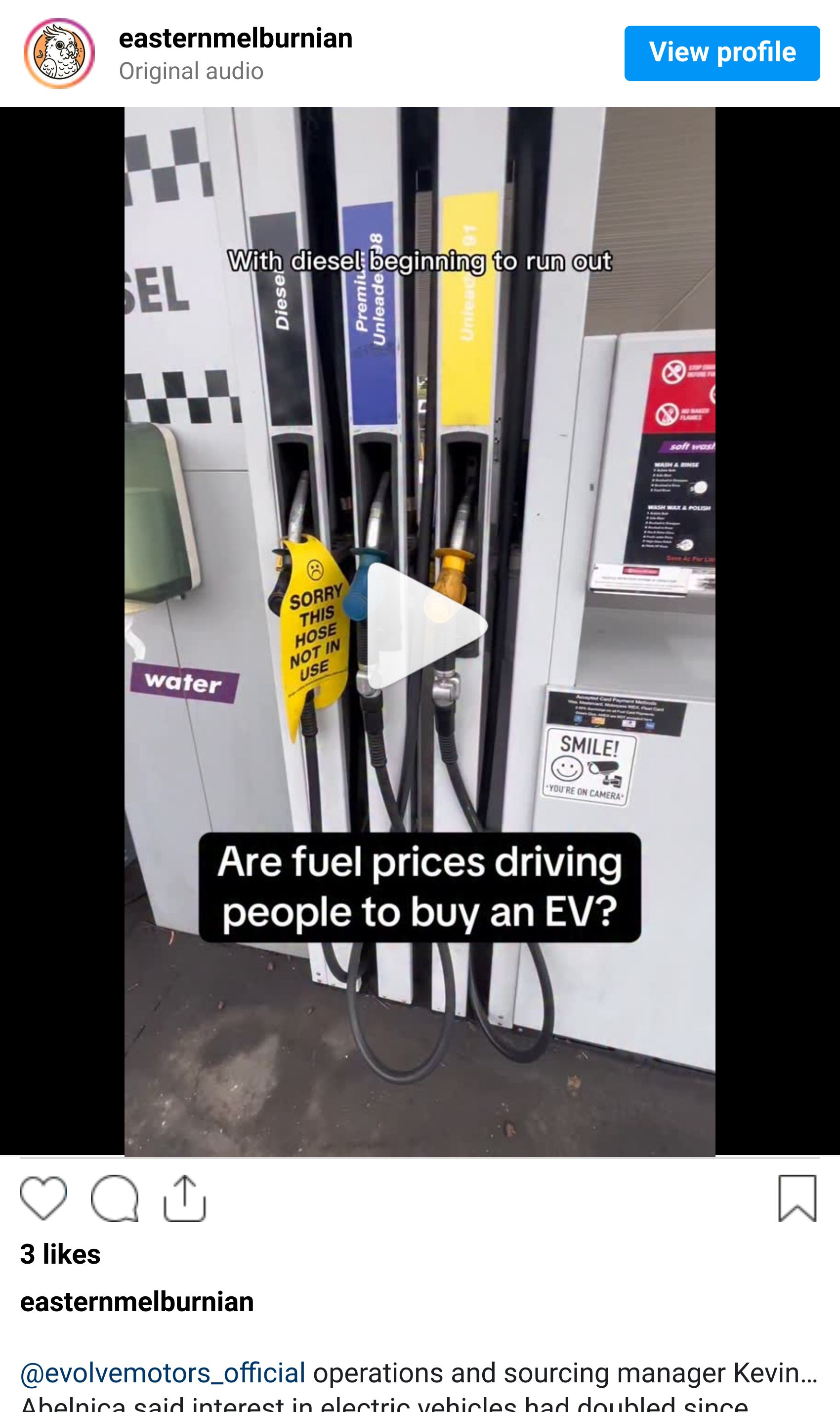

At Oakleigh’s Evolve Motors, operations and sourcing manager Kevin Abelnica says the level of interest in electric vehicles has doubled since petrol price hikes caused by the war in the Middle East.
“We've never seen anything like what's happening right now,” Abelnica told the Eastern Melburnian. “The demand is real and it's not slowing down.”
Abelnica said the auto dealer was struggling to source enough cars to keep up with the demand.
❓ What’s happening? Twenty percent of the world’s oil has to pass from the Persian Gulf through the Strait of Hormuz into the Arabian Sea before being shipped east into Asia and to other destinations.
As of March 16, Australia holds about 37 days of petrol and 30 days of diesel in its reserves, according to Federal Infrastructure and Transport Minister Catherine King.
The limited supply and increasing demand has seen fuel prices rise, with the average price of unleaded petrol currently at about $2.30 per litre and at about $2.70 per litre for diesel across Melbourne’s east.

Prices in Ringwood were as high as close to 240 cents per litre on Wednesday March 18.
📍 EV hotspots: According to the Australian Automobile Association, eastern suburbs with the highest level of registrations for EVs include Glen Waverley (third in Victoria, sixth nationally) and Doncaster (13th in Victoria, 47th nationally).
🪙 Cost breakdowns: Home solar charging is typically the cheapest option, costing almost nothing during sunny periods, whereas public fast chargers can cost between 40c–80c/kWh – or about $48 to fill from empty.

⏭️ What’s next? Australian Security Leaders Climate Group founding executive member Admiral Chris Barrie said expanding the country’s renewable energy production and electrifying transport is the only long-term solution to mitigating climate impacts.
🗣️ “Industries such as freight, agriculture and manufacturing are particularly exposed: transport costs rise, supply chains are disrupted, and inflationary pressures increase,” Barrie said.