

⏱️ The 159th edition of our newsletter is a five-minute read.
Hi there 👋
Matthew Sims here, your reporter at the Eastern Melburnian.
🎥 I’m starting a new video series putting my skills to the test across a range of experiences in Melbourne’s eastern suburbs.
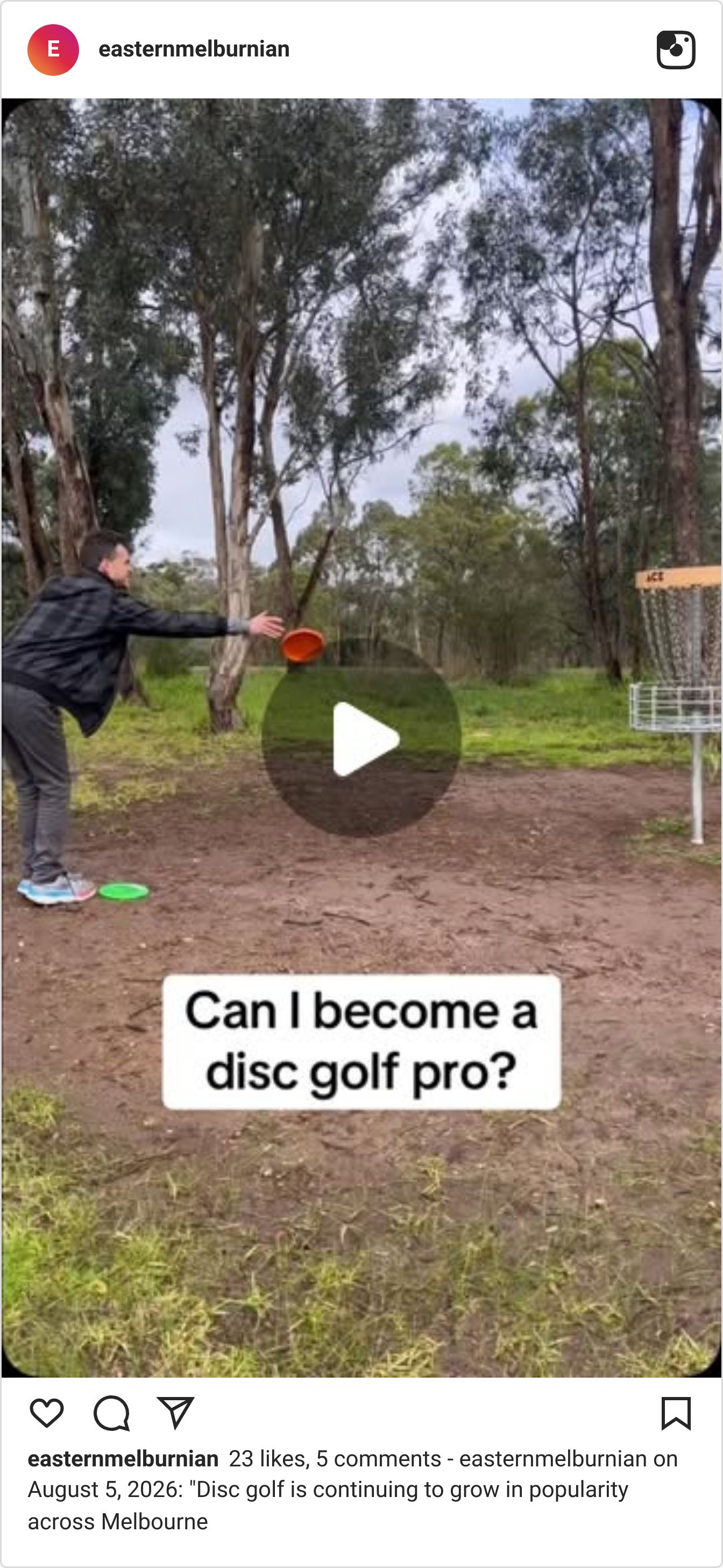
🥏 I started with something relatively slow and easy: disc golf. I had never played disc golf and hadn’t properly flown anything circular since my friends lost our Aerobie in Year 12.
⛳️ I met up with Ross Davies, a member of the Melbourne Disc Golf Club, who showed me the ropes and played a few holes with me. I actually wasn’t playing too badly, until I had to putt.
📬 If you want to see me try something in your patch, reach out via [email protected]
✍️ Researching, writing and editing stories like these is time consuming. If you'd like to support our work, please jump on the link below.

Click this banner to donate!
Today, we’re covering:
The local benefits set to arrive thanks to the Federal Government’s expansion of its solar rebate scheme for small to medium businesses;
The life and legacy of Alistair Knox, who designed more than 1,000 buildings across Melbourne’s east; and
My peek into the world of disc golf.
“I don’t see any drawbacks at all. Whatever we save, we can invest back into the business.”
WHAT’S COMING UP 🎟️
FRIDAY 07/08/26, 7:30-8:40PM | Tell Mama! Karise Eden Sings Janis Joplin
FRIDAY 07/08/26, 8-10:30PM | Things of Stone and Wood
FRIDAY 14/08/26, 8:30-11PM | Dave Hole and Geoff Achison
SATURDAY 15/08/26, 9AM-5:30PM | Victorian State Jigsaw Puzzle Competition
SUNDAY 16/08/26, 6:30PM | The Bennies

📰 THIS WEEK’S HEADLINES
Refrigerated transport company Cold Xpress will save about $230,000 on a new solar system under a Federal Government scheme expansion announced Wednesday that cuts the cost of medium-sized solar installations by about 20 percent.
The Federal Government’s Small-scale Renewable Energy Scheme (SRES) was previously designed to provide discounts for small solar systems up to 100 kilowatts.
Energy Minister Chris Bowen announced the scheme would expand from October 1 to cover systems up to one megawatt, cutting the cost of installing a medium-sized solar system by about 20 percent.
Keeping Cold Xpress’s storage facilities at -25°C requires large amounts of electricity around the clock.
The company helps deliver chilled goods to most major supermarkets and completes about 5,000 deliveries each day across Victoria.
Chief executive John Di Losa founded the company in 1998 with four trucks. It now includes about 180 vehicles across Victoria and expanded to a second Rowville site after buying the neighbouring property in 2024.
The company installed a 750-kilowatt solar system at its main site in 2019, cutting about 25 percent from its monthly power bill, which was around $40,000.
Di Losa said the business had wanted to install solar at the second site but struggled to make the numbers stack up before the scheme expansion.
The company’s annual electricity bill across both sites is about $840,000.
The existing solar system saves between $120,000 and $150,000 a year. The planned one-megawatt system is expected to reduce costs by a further $150,000 to $200,000 annually, cutting the overall power bill by about 32 percent to 41.6 percent.
Alistair Knox designed more than 1,000 buildings across Melbourne's east between 1946 and 1986 — most of them in mudbrick, most of them by hand, and most of them still standing in suburbs like Warrandyte, Donvale and Eltham.
In 1946, Knox enrolled at the Melbourne Technical College to study architecture. He never completed a diploma, but took what he learnt into building houses.
That same year, Knox built two houses in Eaglemont, but quickly realised normal building materials were too scarce following World War II. This led to one of his most significant ideas – using mudbrick.
Being largely self-taught in design and construction, Knox was one of the key figures to pave the way for people to build their own houses.
Speaking to Women’s Day magazine in 1980, Knox said “a house should be … like a natural plant in a natural setting”.
“The house is part of the environment and the environment is part of the house,” he said.
The majority of the signature mudbrick homes he designed and built in Eltham and Warrandyte are still standing, albeit with restorations required or renovations delivered.

Click this banner to donate!
🙋 Are you an eastern Melbourne expert?
Thank you all so much for your responses to the quiz in Wednesday’s newsletter. Below are the answers for you to check how many you got right.
Easy
Q: 🔥 Which venue burnt down in November 2005 and was later rebuilt?
A: Club Kilsyth
🔐 Which hotel on Lilydale’s Main Street has been sitting empty for more than 20 years, with locals campaigning to see it reopened or repurposed?
A: The Lilydale Hotel/The White Dog Hotel/Duke’s Saloon
Medium
Q: 👰 What pub hosted the reception for John Farnham’s wedding and inspired an iconic Australian Crawl lyric?
A: Dorset Gardens Hotel
Q: 🚂 Which train station hosted “refreshment rooms” on the platform until July 2021?
A: Lilydale
Hard
Q: 🗳️ Which local government areas required people to vote on a “liquor licensing poll” before granting a new license until December 2021?
A: Whitehorse and Boroondara

🥵 Finally: As we quickly approach another hot Melbourne summer, the value of our biggest trees is becoming a bigger conversation.
I’m looking into whether councils should start treating mature trees less like landscaping and more like essential climate infrastructure to keep streets cool and make suburbs more liveable.
Do you have a tree in your neighbourhood with a story behind it? Maybe it’s a much-loved local landmark or a tree that was saved from removal? Email me at [email protected]
That’s all from me this time.
Cheers,
Matthew