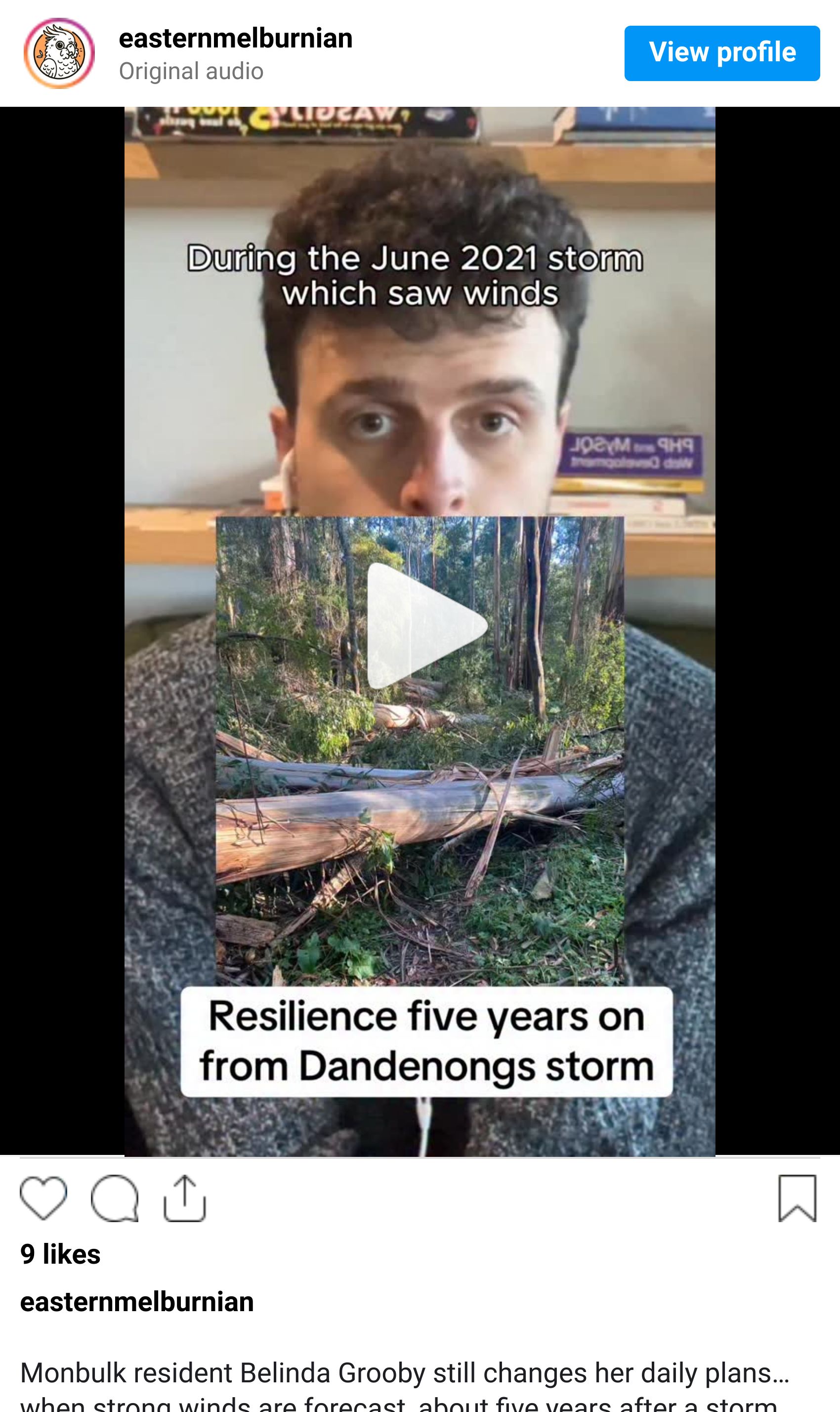

Monbulk resident Belinda Grooby still changes her daily plans when strong winds are forecast, about five years after a storm tore through the Dandenong Ranges.
As trees crashed around her family home in darkness, she feared for her family's safety. Her family is still dealing with the mental impacts of the event.
Grooby is just one of many locals coming to terms with the reality of more frequent and severe weather events in the area.
🍃 Squall strikes: On June 9, 2021, a storm ripped large gum trees from the ground across more than 220 hectares across the Dandenongs, damaging 112 homes and leaving 81 uninhabitable.

Monbulk resident Belinda Grooby said it was a “terrifying night” for her family as they sheltered in darkness while trees crashed around them.
🗣️ “That sound of a freight train never leaves you,” Grooby told the Eastern Melburnian. “You could hear trees falling around you but it was pitch black, so you couldn’t see where they had landed.”
🌬️ Wind wary: Grooby said storm warnings still shape daily life in the Hills, with many residents choosing not to leave home when strong winds are forecast.
“For me, it changes my whole perspective on the day,” she said.
🌑 Dark days ahead: Having experienced multiple severe weather events and power outages, including losing power and phone reception for three weeks after the June 2021 storms, Olinda resident Mark Fergus said focusing only on building resilience was a “Band-Aid approach” and “avoids the hard truths” of the drastic action needed to prevent climate-influenced weather.

And recent national reports have pointed to growing climate risks.
The CSIRO's 2024 State of the Climate report highlighted rising temperatures, altered rainfall patterns and reduced humidity as contributors to harsher weather conditions, while the 2025 National Climate Risk Assessment found climate change will intensify extreme rainfall and winds.
According to the World Health Organisation, the psychological distress caused by exposure to a natural disaster usually improves over time, but some people go on to develop a mental health condition, with an estimated 22 percent at risk of developing a disorder such as depression, anxiety or post-traumatic stress disorder.
Mind matters: Professor Lisa Gibbs from the University of Melbourne said communities hit by disasters experience significantly higher rates of mental health problems, with risks increasing after multiple events.
🗣️ “If you were really challenged the first time and haven’t had a chance to fully recover, it can undermine your capacity to cope,” Gibbs told the Eastern Melburnian.

Lisa Gibbs is the director of the Melbourne School of Population and Global Health’s Disaster, Climate and Adversity Unit
Gibbs said one of the strongest drivers of resilience was community connection.
🗣️ “There’s an absolutely clear association between group membership and mental health outcomes,” she said.
🧒 Younger, more vulnerable: Grooby, who founded youth group Tribe Monbulk Youth in 2018, said local children continue to deal with the trauma in the wake of the storms.
🗣️“We need opportunities for young people to express how they’re feeling and support for parents to have those conversations,” said Grooby. “It’s really about learning to live with the environment now. These events aren’t going away.”