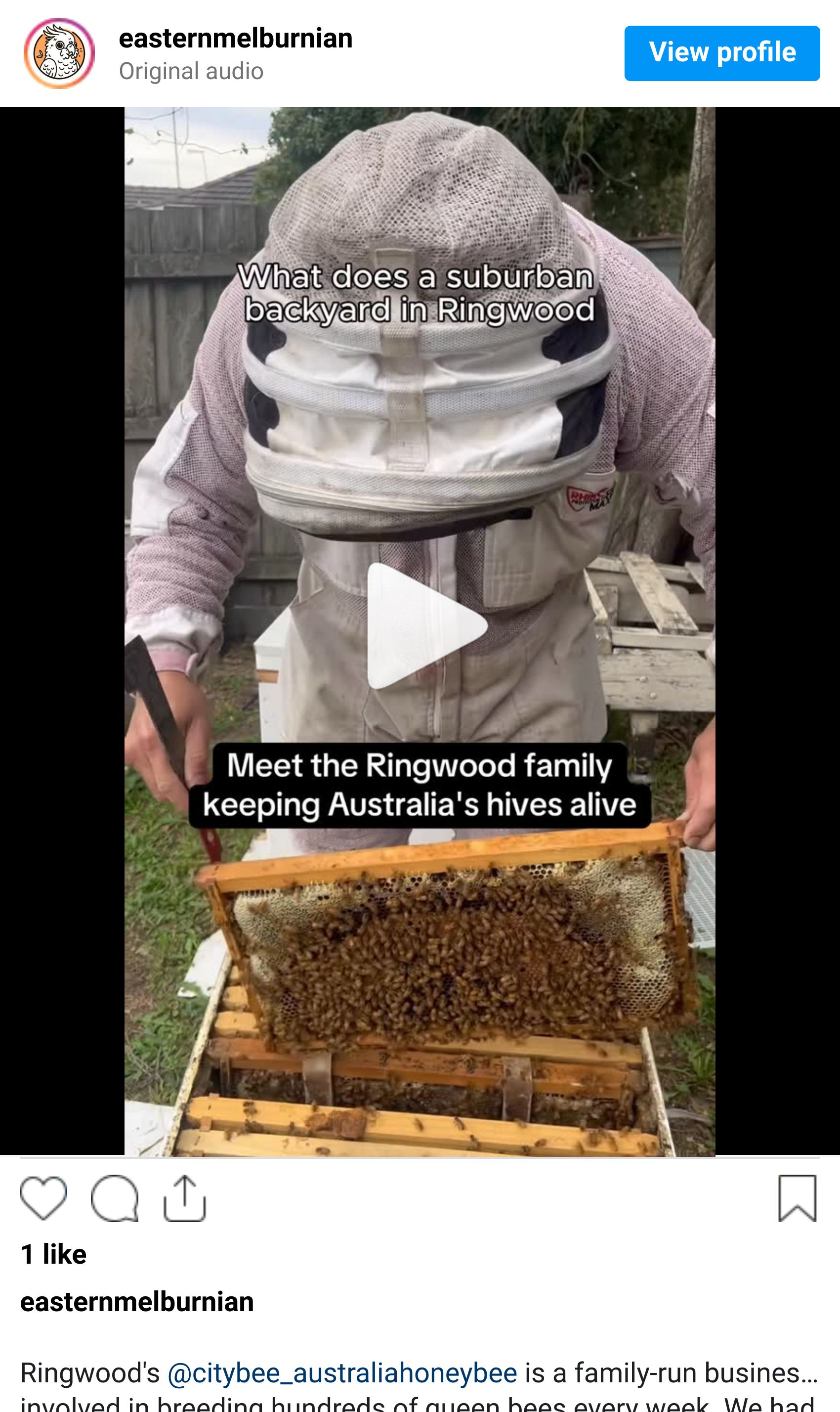

To an outsider, the inside of a bee hive can often look like mayhem.
However, for a Ringwood family business, each bee plays an important role.
City Bee is an eastern suburbs business involved in breeding hundreds of queen bees every week, shipping them across the country to support agricultural production.
🗓️ A long journey: Husband and wife Jack See and Mei Gan arrived in Australia from Malaysia about 13 years ago with a dream to make waves in the agricultural world.
From their backyard in suburban Ringwood and using hives across the region – including in Mooroolbark, Blackburn and Woori Yallock – the couple operate a business that raises queen bees.
🌷 Seeding growth: Bees support a range of essential crops across the country including almonds, blueberries and avocados.
Quick example: Each year, bees from more than 200,000 hives are required to ferry pollen between almond trees from mid-July to early September to support Australia’s almond production. Without bees, Australia and the world’s almond production would essentially stop altogether.

❤️ Caring for thousands: Breeding queen bees involves carefully selecting queens with strong genetics and desirable traits – including a calm nature and high honey production – via a process of checking a queen’s physical characteristics and the overall output of the hive.
See and Gan sell their best-performing queens to beekeepers, who use them to replace older or failing queens in their hives.
🗣️ “Queen breeding is a very technical job — it’s not like just keeping one hive in the backyard,” See told the Eastern Melburnian. “We are not creating just one or two queens, we have to create 200 to 300 every single week.”
👫 A big job for two: Gan said the job was both fun and stressful. It requires constant care for thousands of bees, while also being subject to the ever-changing climate and the increased use of dangerous pesticides in garden care.
🗣️ “Each bee hive is a little bee city, so every bee has their own work to do,” said Gan.

🪲 Small bugs, big threat: See was one of the first people to discover a Varroa mite – a parasite which can cause the collapse of a large colony in a few weeks – in inner-city Melbourne.
Australia had kept varroa mite out for decades, with the pest first discovered in New South Wales in June 2022 and now found across Queensland, the ACT and South Australia.
According to the CSIRO, between 90 and 100 per cent of feral European bee colonies will be lost thanks to Varroa mite.
The Federal Government has estimated about 50 to 60 percent of Australian beekeepers affected by Varroa mite would stop operating.
See said all local beekeepers should check and treat their hives early and ensure the health of their queens.
🗣️ “The queen is so important, because if a hive gets into trouble, the first thing you need is a new queen,” said See.