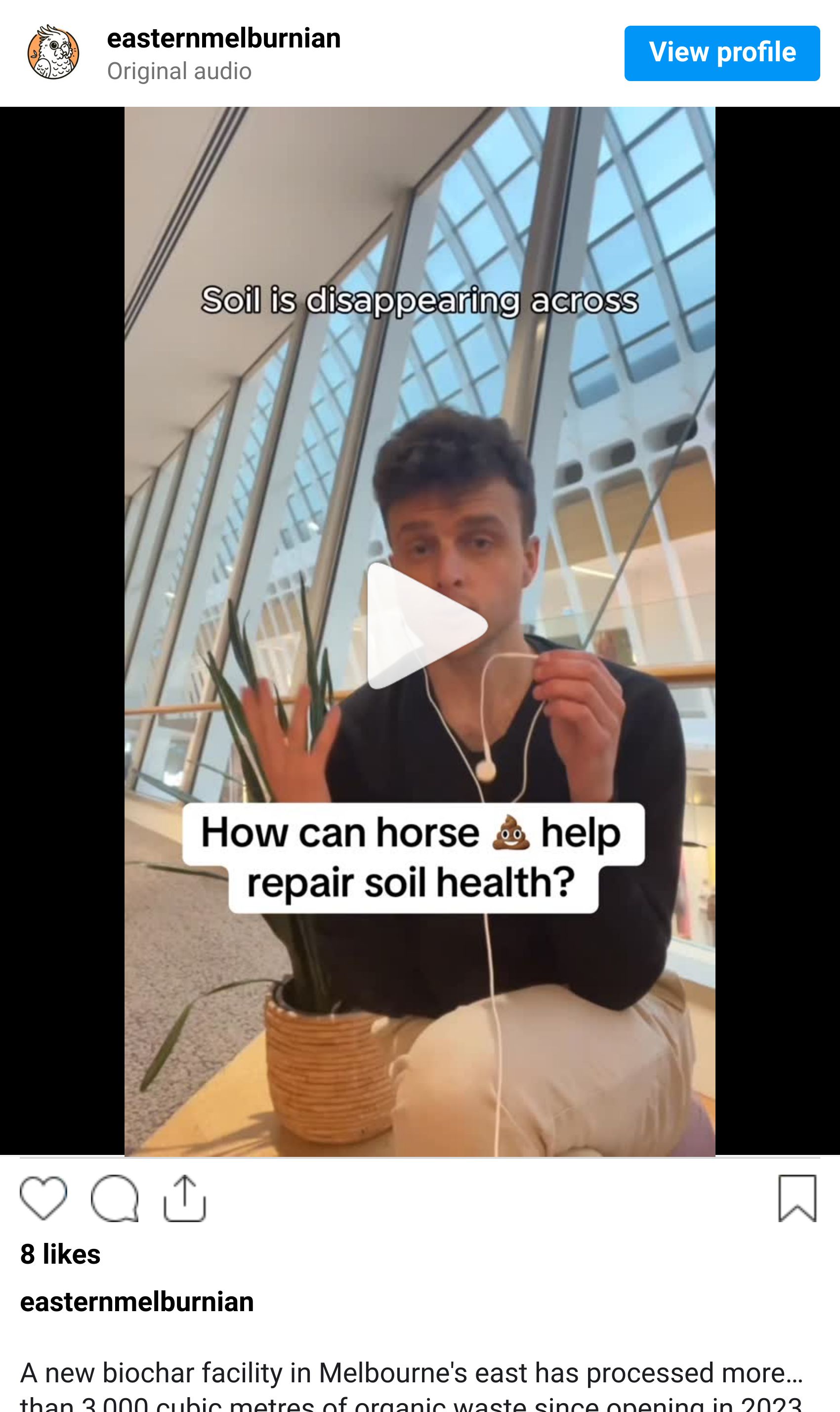

A new biochar facility in Melbourne’s east has processed more than 3,000 cubic metres of organic waste since opening in 2023, with the final product helping Yarra Valley farmers battle soil erosion.
🌱 Why is soil health important? Not-for-profit charity Soils for Life supports farmers in regenerating soils and landscapes.

Chief executive Eli Court said soil was “one of the most complex and biodiverse ecosystems on the planet”.
🗣️ “Just a teaspoon of healthy soil holds 10 billion living organisms,” Court told the Eastern Melburnian. “The difference between life on this planet and no life on this planet is soil.”
An uphill battle: In recent years, increased rainfall and severe weather have accelerated erosion across Australia, with some NSW soils eroding at more than 10 times the normal rate.
In some of Australia’s major wheat-growing regions, about 13 tonnes of soil is lost through erosion for every tonne of wheat produced.
🗣️ “We’re effectively mining soil in the production of our food,” Court said.
🔥 Burn benefits: Made by heating organic material such as forestry waste or manure, biochar is a carbon-rich charcoal that improves soil water retention and nutrient storage.
In late 2023, Yarra Ranges Council and environmental engineering firm Earth Systems launched a biochar facility at the Cleanaway Lysterfield Resource Recovery Centre.
The facility has processed more than 3,000 cubic metres of organic waste, creating more than 900 cubic metres of biochar.

Yarra Ranges Council director of planning and sustainable futures Kath McClusky said turning storm debris into biochar was more sustainable than burning it on site.
🗣️ “Biochar only needs one application over the course of the soil's life,” McClusky told the Eastern Melburnian. “The carbon is stable in the soil for thousands of years, with one gram of biochar boasting a surface area the size of a tennis court.”
🪴 Ground work: The Yarra Valley Ecology, Community, Sustainability Centre (ECOSS) runs a native plant nursery and market gardens in Wesburn.

Biochar program co-ordinator Kylie Barnes said biochar sourced from Lysterfield had increased their crop yields by up to 21 percent.
🗣️ “Healthy soil improves the climate by sequestering carbon dioxide and improving landscape resilience to extreme weather,” Barnes told the Eastern Melburnian. “Urban development has likely caused the most damage to soil health in eastern Melbourne.”
🍇 Grape growth: Wine producer Chandon Australia operates a 41-hectare vineyard in Coldstream, with regenerative practices including diverse soil cover and circular composting.
Estate director Susan Caudry said the changes had allowed the winery to stop using synthetic insecticides two years ago.
⏭️ What’s next? Court said recent global fertiliser supply disruptions due to war in Iran had highlighted the need for more resilient farming.
🗣️ “Industrial systems are very vulnerable to disruption and crisis, and we’re heading into a world full of disruption and crisis,” he said.