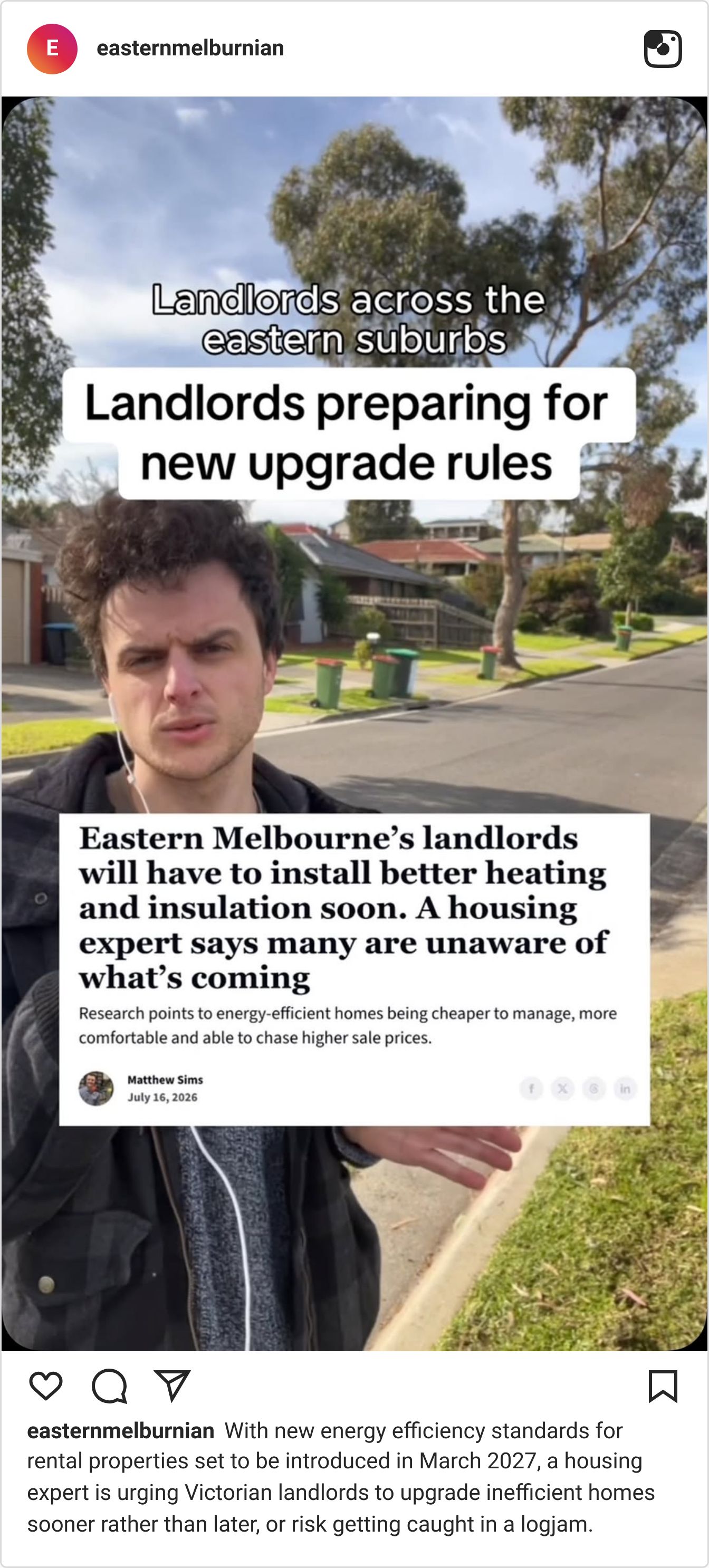

With new energy efficiency standards for rental properties introduced in March 2027, a housing expert is urging Victorian landlords to upgrade inefficient homes sooner rather than later, or risk getting caught in a logjam.
🌡️ Better benchmarks: From March 2027, landlords will be required to install more efficient heating, cooling, hot water systems, shower heads, ceiling insulation and draughtproofing in certain circumstances.
The standards will apply when an existing system fails or can’t be repaired, at the start of a new rental agreement, or if an annual agreement becomes monthly.
A La Trobe University survey of more than 11,000 Victorian rental homes between March 2021 and May 2024 found 54 percent complied with current minimum standards.

🗓️ Now or later? Energy-efficiency upgrades lower utility bills and make homes more comfortable when it’s baking hot or freezing cold, meaning tenants are less likely to consider moving out.
Bell Real Estate director Trevor Bell was doubtful that landlords in the Dandenong Ranges and suburbs in the foothills would be rushing to make upgrades before the changes came into play, but said it was ultimately up to them.

Bell Real Estate director Trevor Bell
🗣️ “We're writing to them about what's coming in,” Bell told the Eastern Melburnian. "If a property becomes vacant within the next 12 months, that would be the ideal time to upgrade."
🪙 Cost benefits: Research from Sustainability Victoria found improving an energy-inefficient Melbourne home from a one- or two-star NatHERS rating (Nationwide House Energy Rating Scheme) to five stars through insulation, draughtproofing and efficient heating, cooling and hot water could cut annual energy bills from about $3,500 to $1,000.
Domain's Sustainability in Property report found homes marketed with energy-efficient features sold for a median 23.8 percent more than comparable homes without them. In Hawthorn, sustainable homes sold for 34.4 percent more, while Kew recorded a 32.8 percent premium.
🔍 Leading the push: RMIT associate professor Trivess Moore, who led a research project into rental retrofits, said awareness of the new standards remained low among landlords, tenants and real estate agents.

RMIT associate professor Trivess Moore
🗣️ “I don't think enough landlords are yet properly aware of what is coming,” Moore told the Eastern Melburnian. “The expectation that the industry would proactively shift has perhaps been a little bit misguided.”
🗓️ Act sooner: Moore said landlords who delayed upgrades could face supply shortages and longer waits for trades if many property owners sought to comply all in one burst when next March hits.
🗣️ “My advice for those who can afford to do so would be to try and make those changes sooner rather than later, because you're going to need to make them,” he said.
Moore said the new standards were relatively modest and early upgrades could improve both tenant comfort and the long-term value aa of rental properties.
⏭️ What’s next? Moore said the priority now should be raising awareness of the changes and encouraging landlords to act while rebates remain available.
🗣️ “More needs to be done to communicate what's happening,” he said. “People don't like change, particularly if they feel it's forced upon them, so trying to explain why this is needed is going to be really important.”
Thumbnail Image Credit: Donaldytong