

⏱️ The 112th edition of our newsletter is a seven-minute read.
Hi there 👋
Matthew Sims here, your reporter at the Eastern Melburnian.
🧑🏫 As stressful as journalism can be, it’s nothing compared to what one group of our society deals with: teachers.
🪧 As the Victorian branch of the Australian Education Union (AEU) pushes towards taking strike action and calling for better pay, I wanted to learn more about how the role of a teacher has expanded from simply reading out of a textbook and marking tests. Teachers are often required to act as therapists, friends, authority figures, role models, social workers all rolled into one.
🥵 I spoke with a local primary school teacher and AEU member named Elise Walker last week, who told me while she loved her job, she and her colleagues felt the education sector had become a “very toxic environment”, with teachers being burnt out by the growing need to manage students’ behaviour while also being undermined by the media, parents and broader society.
📣 I’ll aim to keep on top of this issue as the strike action progresses, but if you’re a local teacher and want to talk, please reach out to me.
Elsewhere:
😰 In the wake of recent heatwaves and bushfires hitting Melbourne and Victoria, I’m also looking into how the rise of “climate anxiety” is impacting parents, as well as how it might influence those who are unsure if they want to take the leap into parenthood during uncertain times.
If you fall into either of these categories, I’m keen to speak with you.
💌 Please reach out to me by simply replying to this email or contacting me via [email protected]
Today we’re covering:
What will the State Government’s gun law reforms mean;
The Victorian branch of the Australian Education Union getting the wheels turning towards taking strike action;
The ongoing tug of war over Oakleigh South’s proposed 1,100-dwelling housing development; and
Knox Council’s decision to pause the approval of a rooming house in Ferntree Gully.
“It's kind of like a bucket with holes in it and you keep trying to fill the bucket up, but you're not trying to plug the holes.”
Elise Walker, a teacher working in a State Government primary school in the south-eastern suburbs, on the issue of retaining the current workforce and why the State Government’s focus on training new staff members is a temporary solution
WHAT’S ON THIS WEEK 🎟️
THURSDAY 05/02/26 & FRIDAY 06/02/26, 8PM | Joe Camilleri and the Black Sorrows
SATURDAY 07/02/26, 8AM-8PM | MS Mega Pickleball
SATURDAY 07/02/26, 12.30-5:30PM | South Croydon Cricket Club’s Pink Stumps Day
SATURDAY 07/02/26, 9AM-5PM & SUNDAY 08/02/26, 9AM-4PM | Artist Alley Melbourne
SUNDAY 08/02/26, 8AM-1PM | Whitehorse Farmers’ Market
SUNDAY 08/02/26, 3PM | Karise Eden

📰 THIS WEEK’S HEADLINES
The State Government is preparing to push through proposed gun law reforms, with public consultation now closed.
While politicians and members of the public have encouraged the reform, arguing the changes would ensure the safety of the community, the proposal has raised concerns from professional and recreational shooters – including in Melbourne’s east – who say they are being unfairly targeted in the aftermath of the Bondi terror attack.
On Tuesday January 20, the Federal Government passed a suite of new gun laws that will:
Fund a national gun buyback, with the specifics of the buyback to be settled with the states and territories;
Strengthen background checks;
Restrict non-citizens from importing firearms;
Tighten importation rules around straight-pull rifles, shotguns, handguns and gel blasters, and remove open-ended permissions to import firearms, and;
Add new offences for sharing or downloading online instructions for how to make or modify weapons.
The State Government also launched a review of its firearm laws, which will consider restricting the types of firearms and gun modifications that are legal and introducing Australian citizenship as a condition for holding a firearms licence.
Public consultation for the review closed on Tuesday February 3.
Victorian Muzzle Loaders Club president John Wakely told the West Vic Brolga there should be restrictions on a range of weapons, but lumping every gun into the same category was a mistake.
“There are a lot of firearms in society that really shouldn't be there: high capacity, rapid-fire shotguns and high-velocity ammunition,” said Wakely. “They have a place for pest controllers and farmers, but people like me and the average Joe, I don't think so.”
Wakely said the guns used by most gun clubs are fundamentally different to rapid-fire guns.
“I think there's about 16 separate steps in loading a muzzle loading, flint lock or percussion firearm,” said Wakely. “They're not huge rates of fire.”
Dave Rowland, a professional culler who provides his services to Yarra Ranges, Knox and Manningham councils, said the potential impacts of proposed reforms would place more restrictions on his business, as he would have to overcome additional barriers to secure gun licences for his employees.
“Guns don't kill people, people kill people,” Rowland told the Eastern Melburnian. “The politicians are so out of touch with reality, it is beyond belief.”
The Victorian government has pledged to consider a final report from the review in March and pass the reforms soon after, with Premier Jacinta Allan saying she was ready to enact the changes.
“We do need to look at the strengthening of laws to stamp out this behaviour,” said Allan.
Victorian Greens leader and Melbourne MP Ellen Sandell has come out in support of the review, saying Victoria has seen a “creeping increase in guns”, with recent figures showing about 960,000 guns were legally owned across the state.
Teachers, education support staff and principals across Victoria are set to fight for better pay and work conditions later this year, after the Fair Work Commission (FWC) gave the green light for workers across the sector to launch strike action.
Earlier this week, the Allan Government bid to interrupt the union's request for a vote on industrial action.
However, FWC deputy president William Richard Clancy decided to approve the AEU Victorian branch’s bid, with matters between the State Government and the AEU Victorian branch discussed and resolved in a meeting on Wednesday.
Before a union launches a request to take lawful strike action on behalf of a group of employees, they must first seek the approval of the FWC to undertake a vote, with all members eligible to either vote for or against the proposed strike action.
The proposed strike action can then only go ahead if at least 50 percent of members voted and more than 50% voted in favour of the industrial action.
The dispute between the government and education union dates back to July last year, when the AEU first called for the Allan Government to deliver a 35 percent pay increase and improved conditions over three years.
In May 2025, the State Government announced it would only contribute 70.43 percent of the Schooling Resource Standard (SRS) – an estimate of how much total public funding a school needs to meet its student’s needs – in 2026 and delay reaching the 75 percent target until 2031. This would leave a $663 million annual shortfall.
Salary forecasts predict that if a new agreement is not put in place by October this year, experienced Victorian teachers will receive up to $15,359 below what their NSW equivalents make annually.
According to a survey conducted by Monash University of 8,000 AEU Victorian branch members, Victorian public school employees work about 12-and-a-half hours of unpaid overtime per week, on average.
Elise Walker, a single mother of three and a teacher working in a State Government primary school in the south-eastern suburbs, told the Eastern Melburnian it was “absolutely ludicrous” that she could not afford to buy a two-bedroom house in her local area with a four-year degree.
Walker said the main issue was a lack of incentives for teachers to stay in what had become a “very toxic environment”, with teachers being burnt out by the growing need to manage students’ behaviour while also being undermined by the media, parents and broader society.
“I feel like it's a shame that we've had to resort to this type of industrial action,” Walker told the Eastern Melburnian. “We're investing in a whole new group of people to be qualified and that's thousands and thousands of dollars, only for them to leave. It's kind of like a bucket with holes in it and you keep trying to fill the bucket up, but you're not trying to plug the holes.”
A spokesperson for the State Government said “negotiations with teacher and principal unions [were] being undertaken in good faith to ensure the right outcome is achieved” for students and staff across all state schools.
Since 2019, the State Government has invested more than $1.8 billion towards improving the school workforce, including the delivery of 14,000 registered teachers since 2020.
A proposal to deliver a large housing development in Oakleigh South is on its final stretch after more than a decade of planning limbo full of appeals and rejections.
But after years of being a hot potato, it seems nobody wants to be in charge of ensuring the site remains safe – with state authorities absent from a key planning meeting and Monash Council arguing it's not their circus to run.
Sterling Global has put forward detailed plans to create a residential community - named Talbot Village - on the site at 1221-1249 Centre Road in Oakleigh South.
The development plan has outlined 10 percent of the dwellings – between 860 and 1,100 – would act as affordable housing.
The height of dwellings would range from two to six storeys and 15 percent of the site would act as open space.
The proposed site is a 18.8 hectare patch that was once a sand quarry and garbage tip. It’s this origin story that has some in the community unsure of the project.
The site operated as a sand quarry from the 1950s to the 1990s and as a landfill from the 1970s to the 1990s, with the largest hole measuring 15 metres deep.
Proposals to rezone the site for residential growth date back to 2014.
The current draft amendment was put before the community last year, before Planning Minister Sonya Kilkenny decided to refer the matter to a Standing Advisory Committee (SAC) for further advice.
The SAC held a public hearing from Monday November 24 to Monday December 1.
According to the amendment documents, the Planning Minister will be the responsible authority for approval of two things: the planning scheme amendment and the broader development plan.
However, Monash Council officers argue the council is likely to be responsible for approving and ensuring compliance of the separate plans.
Council’s concern is that multiple subdivisions would allow for the creation of a number of Owner Corporations, which would lead to confusion as environmental compliance would be the responsibility of several owners.
Remediation works outlined in the planning documents include gas monitoring and venting through a landfill cap – a man-made barrier to control the leakage of methane gas from the landfill.
Last Tuesday, Monash Council moved a motion to write to the Planning Minister to reaffirm it would not be responsible for environmental compliance on the site, arguing it could not meet the financial demands of such a task and would not have the necessary expertise to deal with environmental compliance issues.
Neighbours for Public Green Space Oakleigh South president, Curt Thompson, said the group of locals was calling for the State Government to reject the proposal altogether, as it posed an “unnecessary risk” to the community in terms of potential impacts and loss of local amenity.
“No site such as this has ever been developed for residential housing in Australia,” Thompson told the Eastern Melburnian.
An EPA spokesperson said it has been providing advice regarding the site’s rezoning since 2017, but decided not to attend the most recent public hearing as it is “satisfied that its views are already clear to the committee and the planning authority”
“In the case of Talbot Quarry, EPA considers that sufficient information is available to the planning authority to make a decision on environment protection matters,” said the spokesperson. “EPA continues to regulate the site, which is subject to an Environmental Action Notice that requires ongoing monitoring, with results reported to the EPA.”
The Eastern Melburnian understands Department of Planning and Transport already provided input through consultation, meaning the presence of representatives at the SAC hearing was not required.
Victoria has the poorest delivery of social housing across the country, according to a new report from the Federal Government’s Productivity Commission.
In Knox, the local council has delayed a decision to make its own dent, pausing the approval of a rooming house in Ferntree Gully and pushing the State Government to take on more of the responsibility.
Also known as a boarding house, a rooming house is a dwelling where one or more rooms are for rent.
Due to lower individual cost than a unit or apartment, rooming houses provide housing opportunities to community members who can’t afford to rent privately.
Released last Friday, the Federal Government’s Productivity Commission's Report on Government Services highlighted Victoria came last in terms of its proportion of social housing – 2.88 percent.
Last June, Knox Council received a planning permit application for the construction of a rooming house at 6 Margot Street in Ferntree Gully, including nine bedrooms over a 299-square-metre dwelling.
The council received 44 objections to the application, with submitters airing a range of concerns, including fears the development would lead to an increase in the crime rate.
Knox councillors decided to defer the matter until the next council meeting on Monday February 9.
On Tuesday, Knox councillor Lisa Cooper moved a motion to take a number of actions in light of issues raised by Ferntree Gully residents, including advocating to the State Government for improved standards and requiring planning permits to be required for all rooming houses under planning rules.
Councillor Cooper said the system was unsuitable for residents of the dwellings and their neighbours and there was an “imbalance” in responsibility between the state and local governments.
SEEN THIS WEEK 🤓
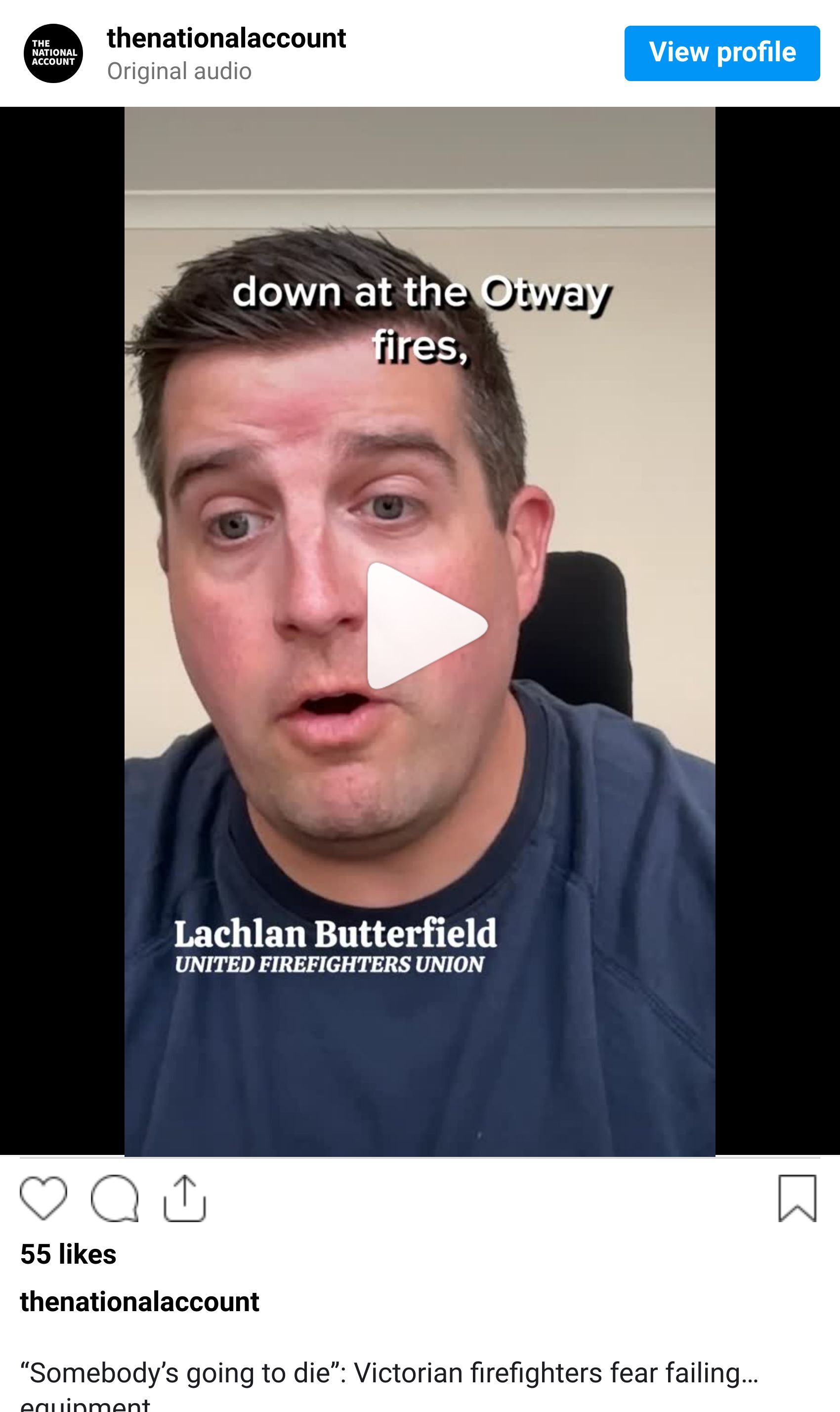
“Somebody’s going to die”: Firefighters fear that failing equipment will end up killing them
The National Account reporter Archie Milligan recently spoke with the United Firefighters Union’s Lachlan Butterfield, who discussed his experiences on the frontline of the recent Otways bushfire and how ageing or out-of-date equipment was often not up to the task.

Thanks for reading this mid-week newsletter and we’ll be back on Friday to shine a spotlight on the under-reported issues in our patch, so stay tuned.
Cheers,
Matthew