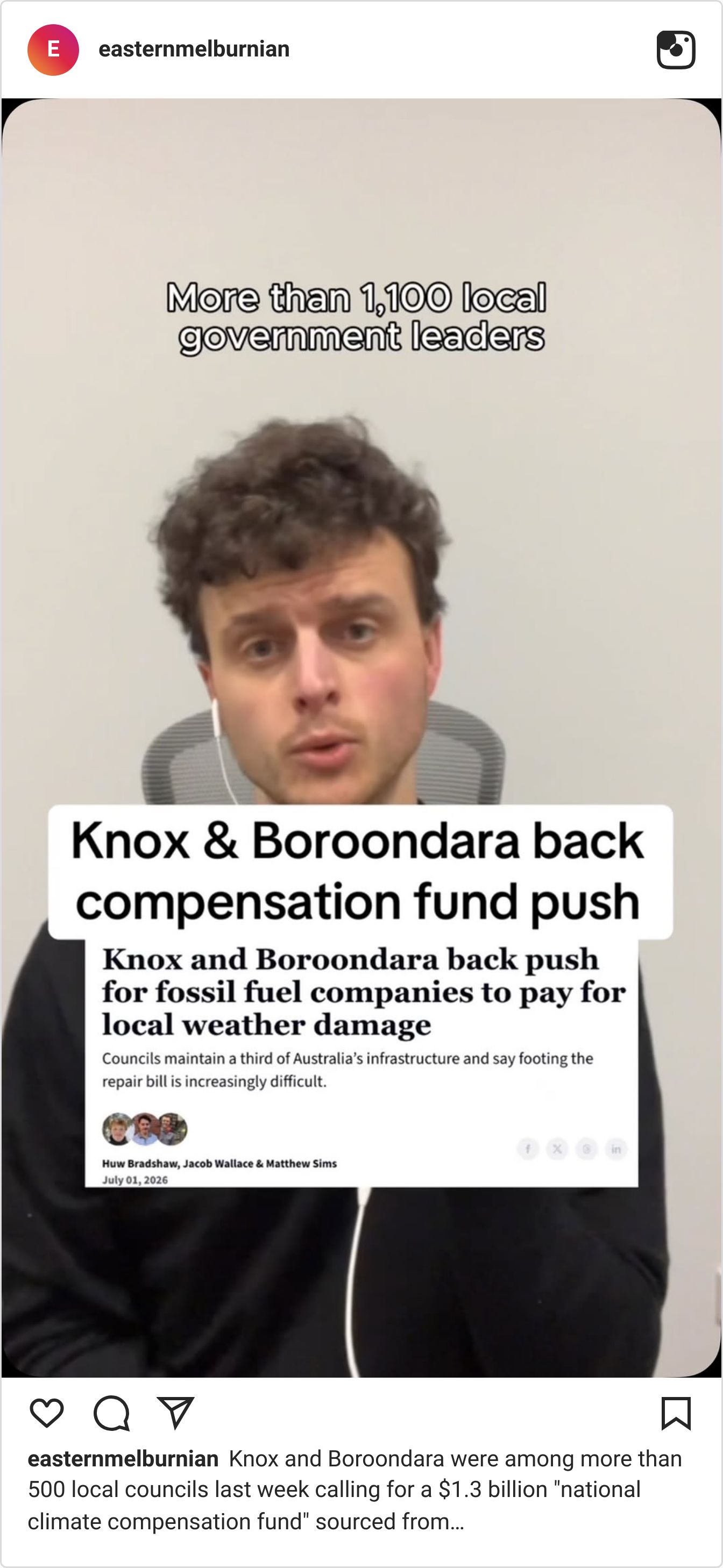

Knox and Boroondara were among more than 500 local councils last week calling for a $1.3 billion “national climate compensation fund” sourced from levies on coal, oil and gas companies to help pay for infrastructure damage linked to climate change.
The impacts of the fossil fuel industry vary between councils, but local governments say they are increasingly carrying the long-term costs of the damage caused by more frequent and severe weather events.
In Melbourne’s eastern suburbs, those impacts include increased insurance premiums and infrastructure damage linked to heat, storms and changing rainfall patterns.
📍 What happened: Last week, more than 1,100 local government leaders from the nation’s councils met in Canberra for the Australian Local Government Association (ALGA) national conference to debate issues affecting communities nationwide.
One of the key topics was the rising financial burden of climate change. Councils said the costs were rising faster than their budgets could cover.
The councils argued fossil fuel companies, rather than ratepayers, should contribute to clean up and repair costs, due to their emissions.

💰 The growing costs: Natural disasters cost Australia an estimated $38 billion annually — about $3,800 per household — and are projected to rise to $73 billion by 2060, according to Deloitte Access Economics.
ALGA said local governments bear a disproportionate share of those costs because councils maintain a third of the nation’s infrastructure, including 75 per cent of roads, forcing more spending on repairs and recovery.
📍 The motion: ALGA, representing 537 councils, voted to ask the Federal Government to establish a $1.3 billion Climate Compensation Fund – consisting of $400 million per year for local government climate adaptation and $900 million per year for improving disaster management.
The motion specified these funds should come through “the implementation of taxes or levies on the coal, oil and gas industries”. The motion passed.
📈 Rising risk: Research from the Australia Institute found the cost of insurance from climate-related disasters is now 12 times higher than 20 years ago, while local government revenue has only tripled.
Kooyong Climate Change Alliance organiser Leigh Naunton said insurance pressures were already affecting communities across Melbourne’s east.
🗣️ “Some people simply can't get insured in flood-prone areas,” Naunton told the Eastern Melburnian. “The underwriting costs more, so the insurance premiums go up right across the board for everybody.”
Naunton said councils were facing rising costs from increased tree canopy and roads damaged by greater stormwater runoff.

Knox mayor Paige Kennett and Boroondara mayor Wes Gault supported the motion.
📍 Council support: Knox mayor Paige Kennett told the Eastern Melburnian a dedicated fund would “ensure the costs aren’t borne by ratepayers through insurance premiums or hefty rebuild costs”.
Boroondara mayor Wes Gault said climate-driven weather events mean “heatwaves will get hotter and longer, rainfall will get more erratic and storms will get stronger”.
🗣️ “Our support for this motion is not about the threat to Boroondara specifically, but reflects our desire to see more action taken by state and federal governments to support councils and the communities we serve,” Gault told the Eastern Melburnian.
Thumbnail Image Credit: Lilydale SES and Heinz van Jaarsveld