

⏱️ The 157th edition of our newsletter is a seven-minute read.
Hi there 👋
Matthew Sims here, your reporter at the Eastern Melburnian.
⛰️ Driving through Knox, it's hard to miss the Dandenong Ranges rising above the suburbs. Recent studies have shown past landslides have carried mud, rocks and fallen trees well into the foothills — and new research is helping map where that could happen again.
⚠️ Knox council is now reviewing how to manage that risk, including whether new planning controls are needed in some areas. This week, I unpacked the findings of a preliminary landslide risk assessment and what happens next.
If you’re in the areas highlighted in Knox’s report, please reach out to me on [email protected].
✍️ Researching, writing and editing stories like these is time consuming. If you'd like to support our work, please jump on the link below.

Click this banner to donate!
Today, we’re covering:
Knox council’s ongoing process to assess erosion and landslide risk;
Boroondara council’s sudden decision to introduce a cat curfew, after officers advised against the new controls; and
The story behind the Prussian emigrant who built Mitcham’s 1880s stone cottage.
“We need as many unregistered cats to be registered and for people to take responsible ownership of those cats, not letting them run riot.”
WHAT’S COMING UP 🎟️
SATURDAY 01/08/26, 7:30-9:30PM | Lior
THURSDAY 06/08/26 TO SATURDAY 08/08/26 | Anne of Green Gables
THURSDAY 06/08/26 TO SATURDAY 29/08/26 | Treasure Island
FRIDAY 07/08/26, 7:30-8:40PM | Tell Mama! Karise Eden Sings Janis Joplin
FRIDAY 07/08/26, 8-10:30PM | Things of Stone and Wood
FRIDAY 14/08/26, 8:30-11PM | Dave Hole and Geoff Achison
SATURDAY 15/08/26, 9AM-5:30PM | Victorian State Jigsaw Puzzle Competition
SUNDAY 16/08/26, 6:30PM | The Bennies

📰 THIS WEEK’S HEADLINES
Heavy rain in the Dandenong Ranges can turn hillsides into fast-moving rivers of mud, rocks and fallen trees, with debris travelling more than a kilometre downhill within three to four minutes.
Hoping to reduce risk to properties, Knox council is looking at planning controls to encourage more resilient development within the foothills by preventing new homes being built in unstable locations.
Knox’s most recent recorded “debris flow” – a landslide that behaves like a river of mud and boulders due to heavy rainfall – occurred in 2020 along Burwood Highway in Ferntree Gully after heavy rain, likely worsened by vegetation loss.
A year later, severe storms in June 2021 triggered widespread landslides – when soil, rocks and vegetation moved down a slope – across the Dandenong Ranges.
In November 2025, Knox council commissioned a preliminary landslide risk assessment to determine whether parts of the municipality should also be subject to planning controls after research showed debris flows from the Dandenong Ranges could reach Knox.
Knox Council's Climate Response Plan recognises climate change is increasing the frequency and intensity of heavy rainfall and storms, placing greater pressure on slopes, drainage systems and infrastructure.
At its meeting on Monday July 27, Knox councillors agreed to begin a detailed assessment that could eventually lead to an Erosion Management Overlay – a planning control for land at risk of landslides or debris flows.
The initial study found debris flows could impact areas and properties in Knox because of their speed and destructive potential.
If a property is included in an EMO, owners seeking planning approval for development or earthworks would need a geotechnical assessment to demonstrate the land is safe.
Council staff will now complete property-level assessments over the next six to nine months towards developing a plan to reduce the risk of future landslides damaging homes and infrastructure.
The next stage will focus on The Basin, Ferntree Gully, Upper Ferntree Gully and Lysterfield, with affected property owners set to be consulted before work commences.

Boroondara's estimated 15,000 cats — two-thirds of them unregistered — will be subject to a night-time curfew under a council decision that divided both residents and councillors.
Boroondara is estimated to have almost 15,000 cats, including 4,816 registered and 10,071 unregistered.
On Monday night, councillors voted to require registered cats to be kept inside between sunset and sunrise. The council will also investigate employing an animal management officer and research how other metropolitan councils manage cats and their impact on wildlife.
More than 3,650 residents responded to consultation, with support almost evenly divided between a night-time curfew (38.4 percent), a 24-hour curfew (37.8 percent) and no change (23.8 percent).
Six of 10 councillors backed the curfew, with opponents argued the curfew unfairly targeted registered cats while unregistered cats remained the bigger problem.
Residents could humanely trap roaming cats and ask the council to collect them. Registered cat owners would usually receive a warning before a $102 fine for repeat offences, while unregistered cats would be impounded.


Click this banner to donate!
🙋 Are you an eastern Melbourne expert?
Thank you all so much for your responses to the quiz I put together in the Wednesday newsletter. Below are the answers for you to check how many you got right.
Let me know if you want me to keep this running, if each week should follow a different theme or if you think I made the questions too easy or too hard.
Q: 🌳 What suburb is known as the “gateway to the Dandenongs”?
A: Ferntree Gully
Q: 🏘️ What is the name of the street which serves as Ramsay St in the iconic soap opera Neighbours?
A: Pin Oak Court
🥇 Where was Victoria's first official gold discovery made in 1851?
A: Warrandyte
🏟️ What is the name of the first venue to be built specifically for Australian rules football?
A: Waverley Park
🚗 What is the name of the major north-south road running from Bayswater to Dandenong?
A: Stud Road

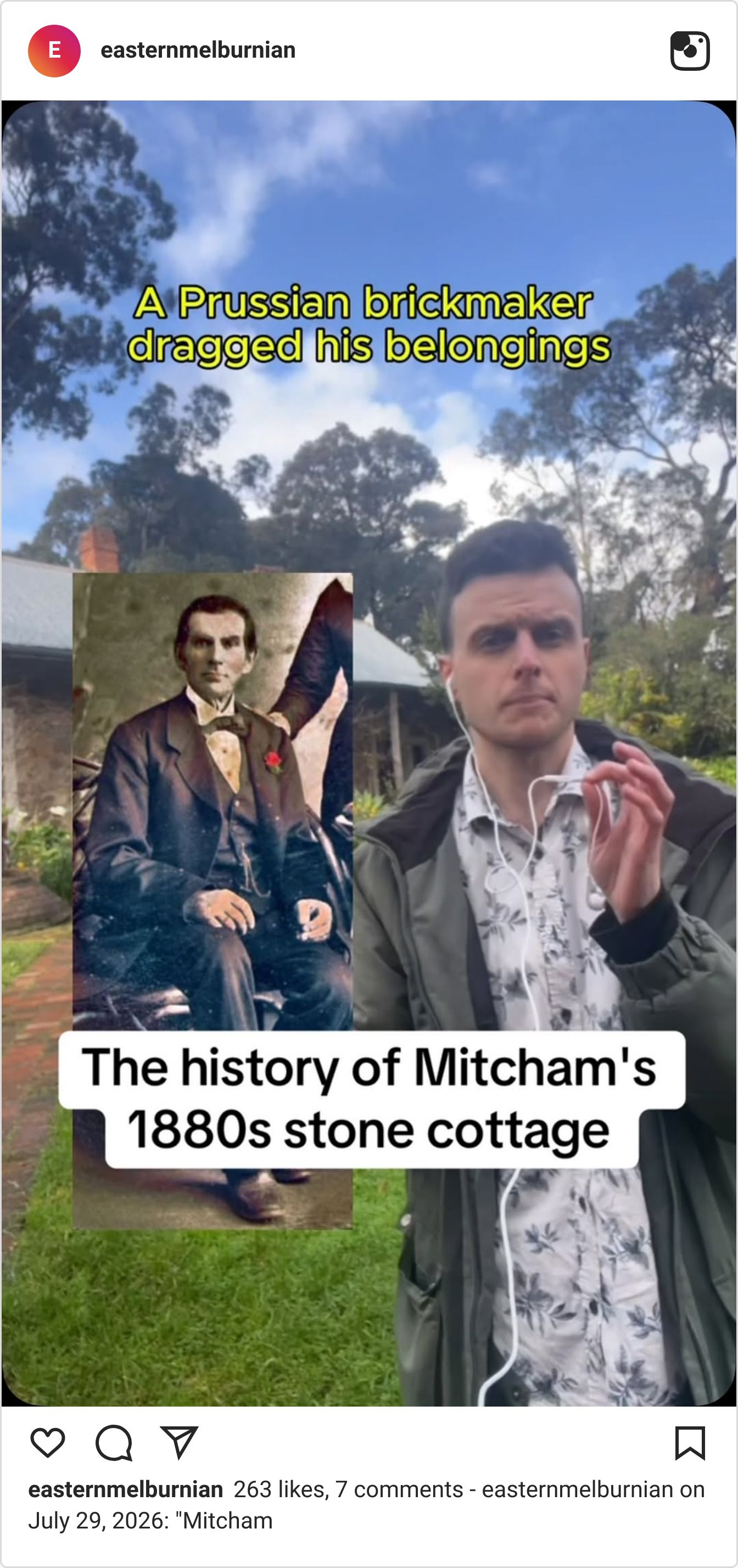
🪨 Finally: I took a trek to Mitcham’s Schwerkolt Cottage on Wednesday afternoon. It was always something I’d seen pop up on maps, but I never really took the time to look into what it was or the story behind it.
At the centre of its history is a Prussian emigrant named August Schwerkolt, who built it using materials sourced from the land in Mitcham.
I was lucky enough to meet August’s great-granddaughter Rosalie Whalen, who took me through the family tree and clarified some of the history for me. It’s amazing that a piece of history is still being maintained all these years later. The cottage is open 1pm to 4pm Saturdays, Sundays and most public holidays.
That’s all from me this time.
Cheers,
Matthew