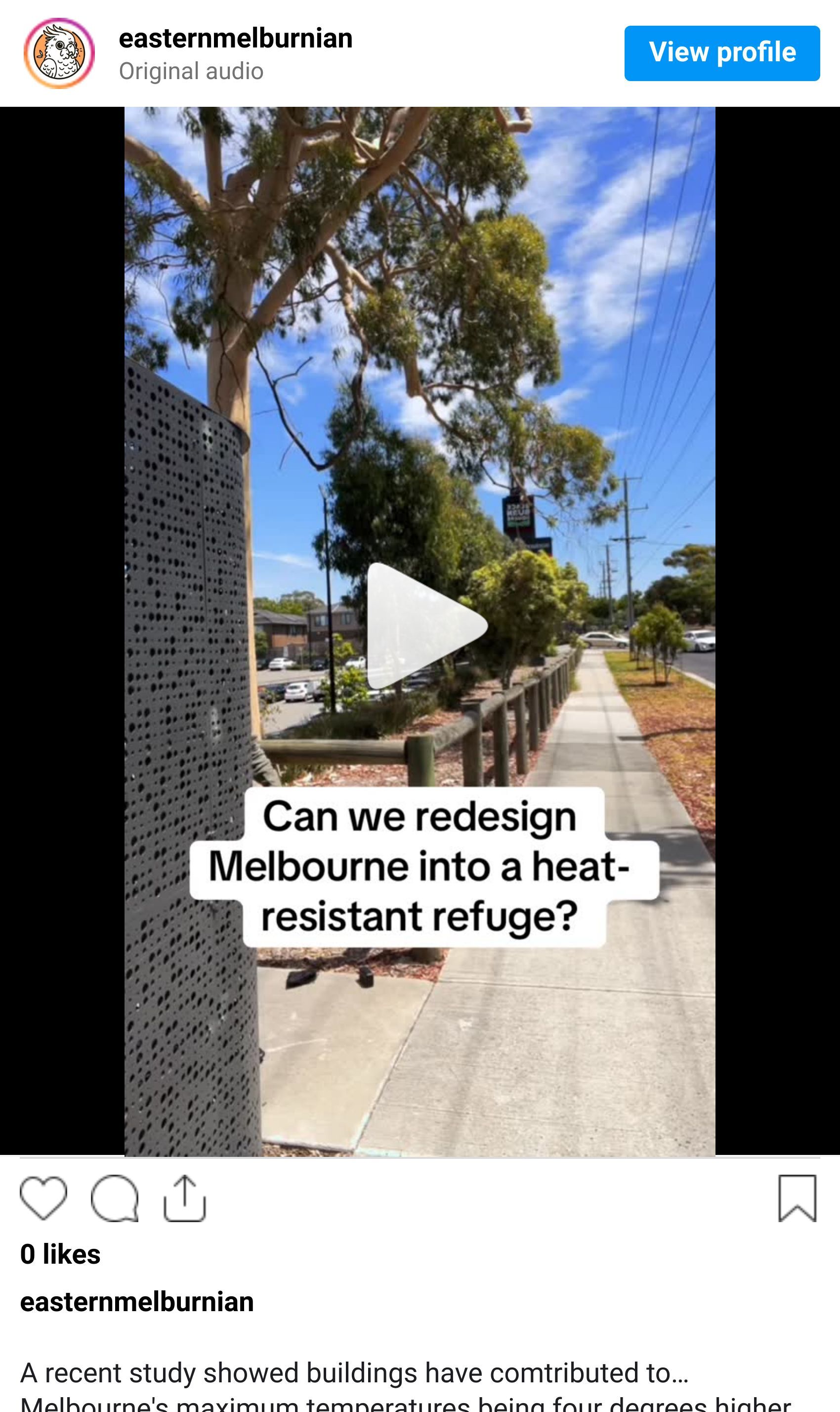

As record-breaking heat hits Victoria, experts say we need to rethink how our cities are designed or face a future where our cities are increasingly unlivable.
🌡️ Record-breaking temps: Victoria broke its record for the hottest temperature ever recorded on Tuesday, with Walpeup in the state’s north reaching 48.9 degrees.
Parts of Melbourne breached the 45-degree mark, while Melbourne Airport hit 44.1 degrees.
According to the Bureau of Meteorology’s 2025 preliminary summary, Australia experienced its fourth-warmest year on record last year, with temperatures 1.23 degrees above the 1961-1990 average.
🤞 Still hope but action needed: University of Melbourne Senior Research Fellow, Doctor Judy Bush, is an expert on nature-based solutions to climate change’s impacts on cities. She told the Eastern Melburnian there’s still hope to use our natural resources to make our cities capable of withstanding longer and hotter conditions – but action needs to be taken.
Bush said governments’ priorities should be shifting towards adapting our cities to deal with climate impacts, not aiming to avoid them altogether.
“Vegetation is one of the most effective and equitable ways to cool cities,” Bush said. “Governments at all levels have a huge role, but so do businesses and individuals. In cities like Melbourne, we have the capacity to take action that can have local results and also global results.”

🥵 More heat on the way: A recent study from the World Weather Attribution, looking at the January 5 to 10 heatwave that hit south-eastern Australia, found it was the most severe in six years.
The research also found:
The heatwaves seen during this period had shifted from a one-in-25-year event to a one-in-five-year event in today’s climate;
The intensity of heatwaves would become three times more likely if the globe warms by another 1.3 degrees – a threshold we are set to reach by 2100 under current policies
Australia’s extreme heat events have become more frequent and more intense due to human-induced climate change.
☀️ Who’s getting hit? Developed by RMIT researchers, the Heat Vulnerability Index found Melbourne’s outer suburbs had the highest vulnerability to extreme heat, due to limited tree cover and strong urban heat-island effects.
😎 Greener, cooler future: A 2023 study from the Australian National University and CSIRO predicted that if Melbourne’s infrastructure was moved towards including more ground-level vegetation and reflective roof surfaces, air temperatures would drop by 2.4 degrees.

⏭️ What’s next: Bush said the key places to target in terms of building with heat-resistant materials should be where people are the most vulnerable to extreme heat, including connections between transport hubs and other social and lifestyle hubs and cycling paths.
University of Melbourne Faculty of Architecture, Building and Planning research highlighted most of inner Melbourne’s bike lanes have less than 40 percent canopy cover.
🗣️ “While you can plant trees beside existing cycle paths, those trees are going to take 15 years at least to develop sufficient canopy to shade cycle paths,” said Bush. “We need to be thinking about locating cycle paths on existing treed roads.”