

⏱️ The 110th edition of our newsletter is a seven-minute read.
Hi there 👋
Matthew Sims here, your reporter at the Eastern Melburnian.
Victorian communities are being hit from all sides when it comes to natural disasters, with south-west Victoria ravaged by ongoing fires and flood damage recently.
The West Vic Brolga’s Zara Cuthbertson has been caught in the middle of the chaos, and was evacuated from her home late Monday evening.
I thought it was worth spotlighting this first-person account at the top of today’s newsletter. Zara is safe now, but is just one of more than a thousand who have been told to leave their homes and head to safety over the last 24 hours.
🎤 View her chat with Archie Milligan from the National Account below or listen to the podcast here.
🔥 Closer to home in Melbourne’s east, locals have reported lower air quality due to smoke coming from fires burning across the state. While it didn’t elicit much more of a reaction from me than noticing the smell, it got me thinking: how can smoke or low air quality during bushfires impact young or old people with existing lung problems like asthma?
🔎 This week, I’ll be looking further into this question, speaking with parents, the elderly and young folks from Melbourne’s east, to see how they’re coping with these heatwave conditions.
If you’ve got something to add, please feel free to reach out via [email protected].
Today we’re covering:
The “charging deserts” found across regional parts of the country and how local EV charging infrastructure is needs to change to keep up with the growing demand; and
A fatal single-vehicle collision in Ferntree Gully that killed two 18-year-old men.
“Charging infrastructure should not be dictated by the postcode where we live.”
Associate Professor, Hussein Dia says more than two-thirds of towns have no EV charger within five kilometres, meaning long trips had created what is known as “range anxiety”.
WHAT’S ON THIS WEEK 🎟️
FRIDAY 30/01/26, 6PM, SATURDAY 31/01/26, 9.30AM, 12.30 and 3.30PM & SUNDAY 01/02/26, 9.30AM ,12.30 & 3.30PM | Bluey’s Big Play
FRIDAY 30/01/26, 8-10.30PM | Jason Vorherr, Kane Vincent and Ricki Wood @ Upwey Belgrave RSL
SATURDAY 31/01/26, 7.45AM | Tough Mudder @ Caribbean Gardens
SUNDAY 01/02/26, NOON-6PM | Lilydale Bowling Club Community Day

📰 THIS WEEK’S HEADLINES
Each year, more and more electric vehicles (EVs) hit the road in Melbourne and greater Victoria.
However, recent research has highlighted charging infrastructure hasn’t kept up with demand, leaving key connections between major cities as “charging deserts”.
According to a report from the Australian Automobile Association (AAA), the latest data from the July to September period showed EV sales in Victoria accounted for about 11 percent of new vehicle sales, up from seven percent a year prior.
While there are about 7,000 petrol stations dotted around Australia, electric vehicle (EV) owners – about 410,000 as of last September – were less spoilt for choice, with about 1,250 public charging stations offering about 3,750 ports.
Australian Electric Vehicle Association Victorian branch director, Riz Akhtar, said while Victoria was gaining traction, with about 95,000 EVs on the road, the state was “quite a bit behind” other states like New South Wales, which recently surpassed 104,000 EVs on its roads.
“The government says they want to do all these things, but they don't realise the amount of investment that's needed and how to drive that investment forward,” Akhtar told the Eastern Melburnian.
The Federal Government has committed $40 million to accelerate the deployment of EV charging infrastructure towards reaching 10,000 public chargers nationwide.
The State Government is also conducting an inquiry into the electricity supply for electric vehicles, with hearings set to take place covering topics such as whether public charging infrastructure is being rolled out quick enough across Victoria.
Swinburne University of Technology Centre of Sustainable Infrastructure Associate Professor, Hussein Dia, helped develop the Australian EV Infrastructure Monitor – an online mapping tool showing where charging stations exist across Australia.
Dia said more than two-thirds of towns have no charger within five kilometres, meaning long trips had created what is known as “range anxiety”.
“Charging infrastructure should not be dictated by the postcode where we live,” Dia told the Eastern Melburnian.
“If we really want to provide adequate uptake of EVs, we need to have an equitable distribution of where the uptake is. It is just not acceptable to go on a trip and know, even if you are fully charged, that the next charging station is 300 kilometres away.”
Rob Law, an EV owner living in a regional town northwest of Melbourne, said he was less anxious about having enough charge to get to his destination.
“The good news is that there's more and more chargers, but the challenge now is keeping up with the demand,” Law told the Eastern Melburnian. “I'm often finding that I have to wait up to an hour or two just to use a single charger.”
Dia said more government incentives needed to be made available to charging infrastructure providers looking to install in regional or rural areas to quickly catch up with growing demand.
For instance, Dia said the Western Australian Government had shown positive initiative by funding up to 50 percent of the cost of electric vehicle charger installations for companies, local governments and not-for-profits.
“I think the private sector is crying out for these guidelines,” said Dia. “You need to put the infrastructure in place, even in the beginning and as we get more vehicle electric vehicle uptake, they will get better utilisation.”
Victoria Police are investigating the circumstances of a fatal single-vehicle collision in Ferntree Gully over the weekend that killed two male 18-year-old passengers.
What happened: Police said a car crashed into a pole on Oaklands Avenue at about 5.55pm on Saturday January 24, with an 18-year-old Blackburn man and an 18-year-old Sandhurst man dying at the scene.
The third man, a 19-year-old man from Ferntree Gully, was taken to hospital in an ambulance with a police guard and has been released.
Major Collision Investigation Unit detectives are expected to interview him at a later date.
The circumstances surrounding the collision are yet to be established and the investigation remains ongoing.
Anyone who witnessed the incident, with footage or information is urged to contact Crime Stoppers on 1800 333 000 or make an anonymous report via www.crimestoppersvic.com.au
SEEN THIS WEEK 🤓
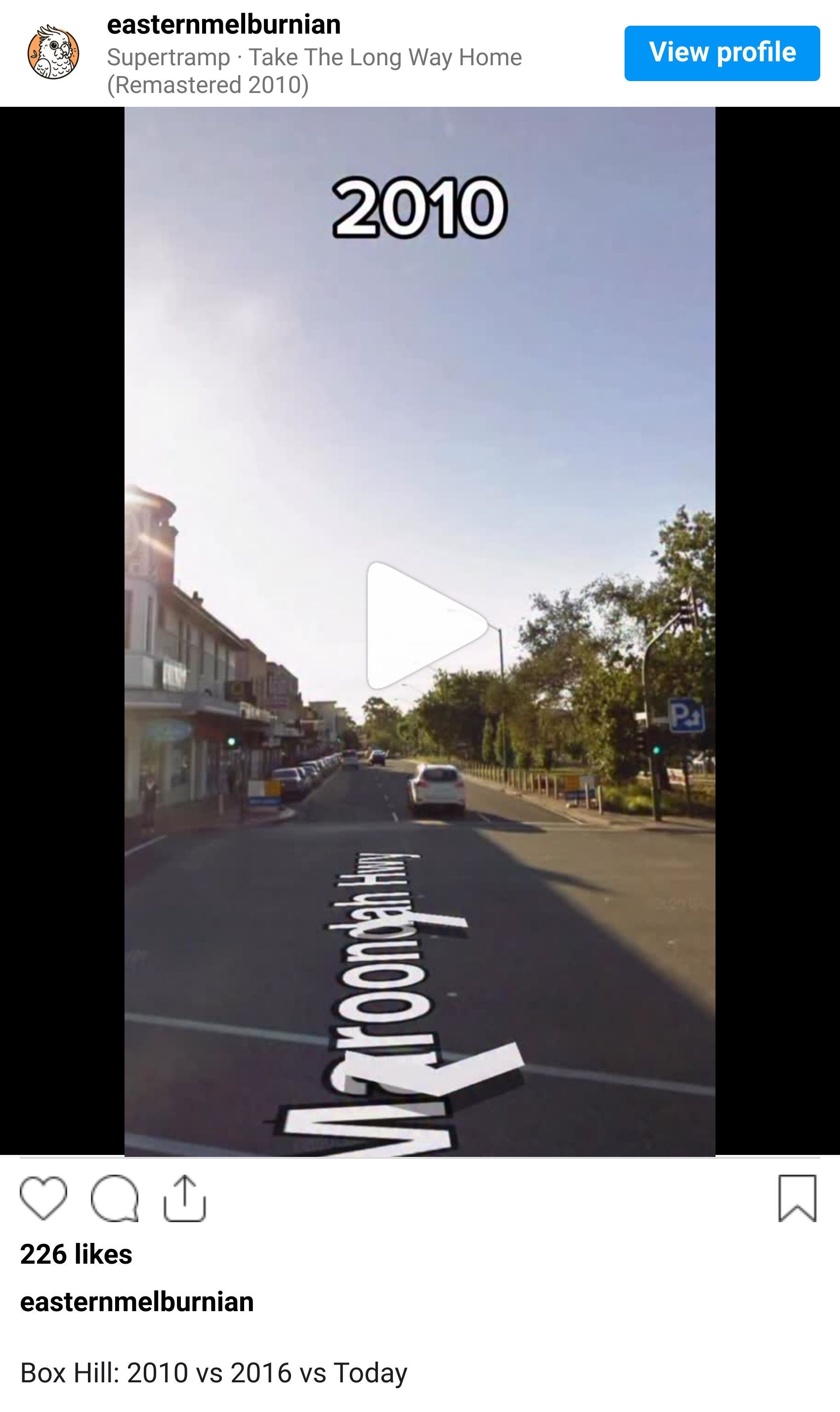
How much has Box Hill changed over the years?
Over on our video platforms, we jumped on Google Street View to take a look at how some of our key towns have changed over the years. It was quite shocking to see how Box Hill looked like a small regional town in 2010, but is becoming a key urban hub for Melbourne’s ever-growing east as of today.
Let me know which town you’d like me to highlight next

Thanks for reading this mid-week newsletter and we’ll be back on Friday to shine a spotlight on the under-reported issues in our patch, so stay tuned.
Cheers,
Matthew